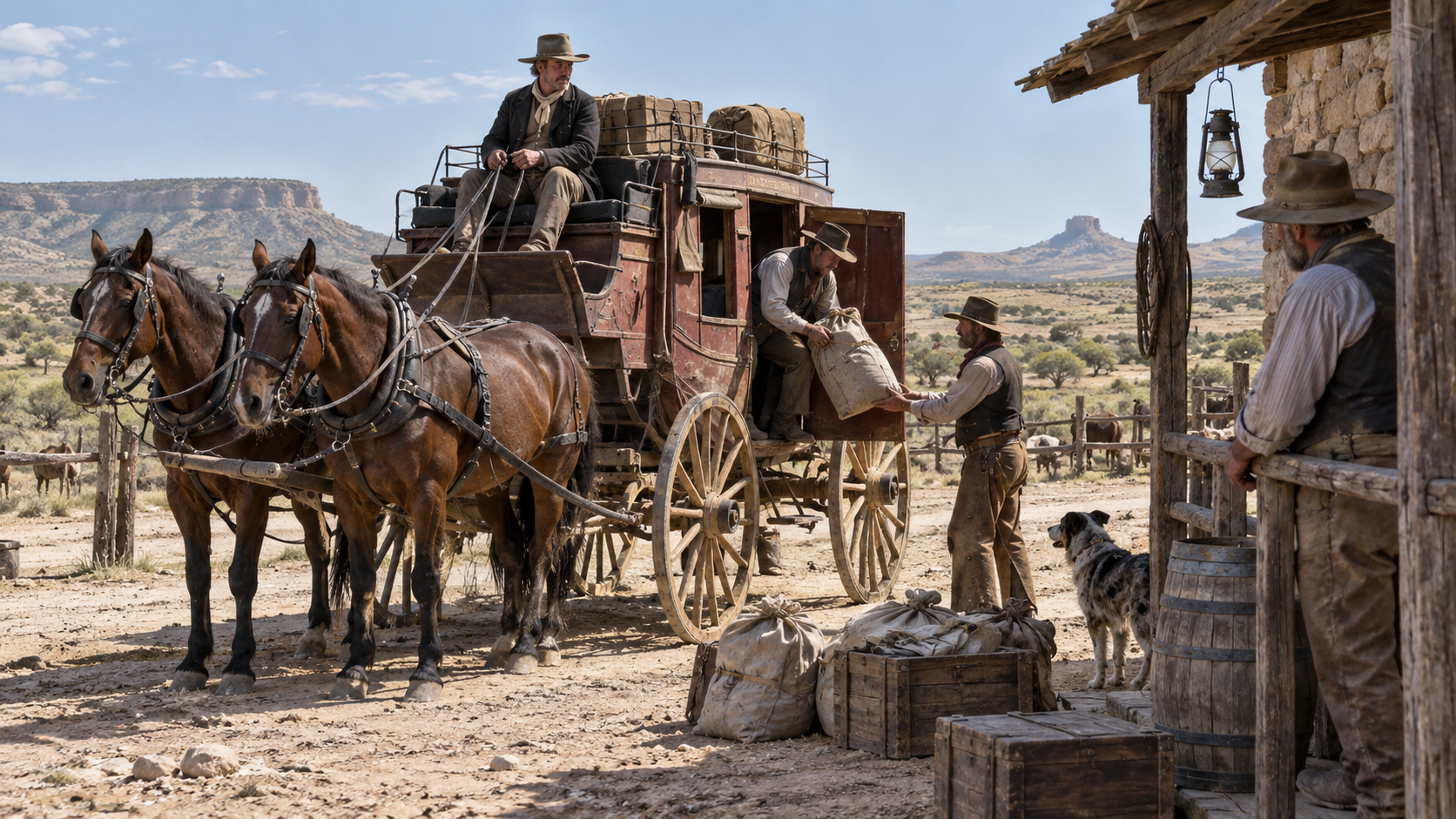
Source-led question: Why did the first regular overland mail route to California take a long southern arc?
When people picture a stagecoach route to California, they often imagine a straight line across the center of the continent. The Butterfield Overland Mail did something different. Its route curved through the southern rim of the United States, crossing Missouri, Arkansas, Texas, New Mexico, and Arizona before turning north toward California. The shape was not an accident. A southern route offered a chance at year-round service when winter conditions could close northern passes. Congress authorized a large mail contract in eighteen fifty-seven, and John Butterfield became the businessman responsible for making it work. The contract connected the growing communities of the Far West with eastern markets and government offices. It was a public infrastructure project carried by private stagecoaches. The route had to be surveyed, stocked, scheduled, and defended well enough to make a promiseThe route had to be surveyed, stocked, scheduled, and defended well enough to make a promise of regular delivery.
What the record supports
- Documented: Congress authorized a large mail contract for John Butterfield in 1857.
- Documented: The route connected eastern termini on the Mississippi with San Francisco through a southern arc.
- Documented: Stagecoaches began regular service in 1858, twice each week.
- Documented: The service lasted less than three years and was disrupted by the Civil War.
- Documented: The route reduced reliance on a slower mail journey through the Isthmus of Panama.
The episode uses clearly labeled synthetic reconstruction imagery for explanation. Those images are not archival photographs and do not establish that an uncertain detail was witnessed.
The source trail keeps documented facts separate from inference. The episode follows the strongest available records and leaves unresolved parts visible; a missing record is not evidence for a precise route, invented dialogue, recovered object, or modern valuation.
Continue the series
- Western Stories index
- Old West hub
- Continue with the next source trail
- Subscribe to Old West source trails
Sources
- Butterfield Overland National Historic Trail: A Brief History — Starting in 1858, stagecoaches left twice a week and could reach San Francisco in 25 days or less.
- John Butterfield — The contract was authorized by Congress in March 1857 and connected St. Louis with San Francisco.
- Butterfield Overland Mail route interpretation — The route followed a southerly course through Missouri, Arkansas, Texas, Oklahoma, New Mexico, and Arizona.
Media note: This page uses an authorized synthetic reconstruction image. The historical claims remain tied to the source links above.
Loading comments…