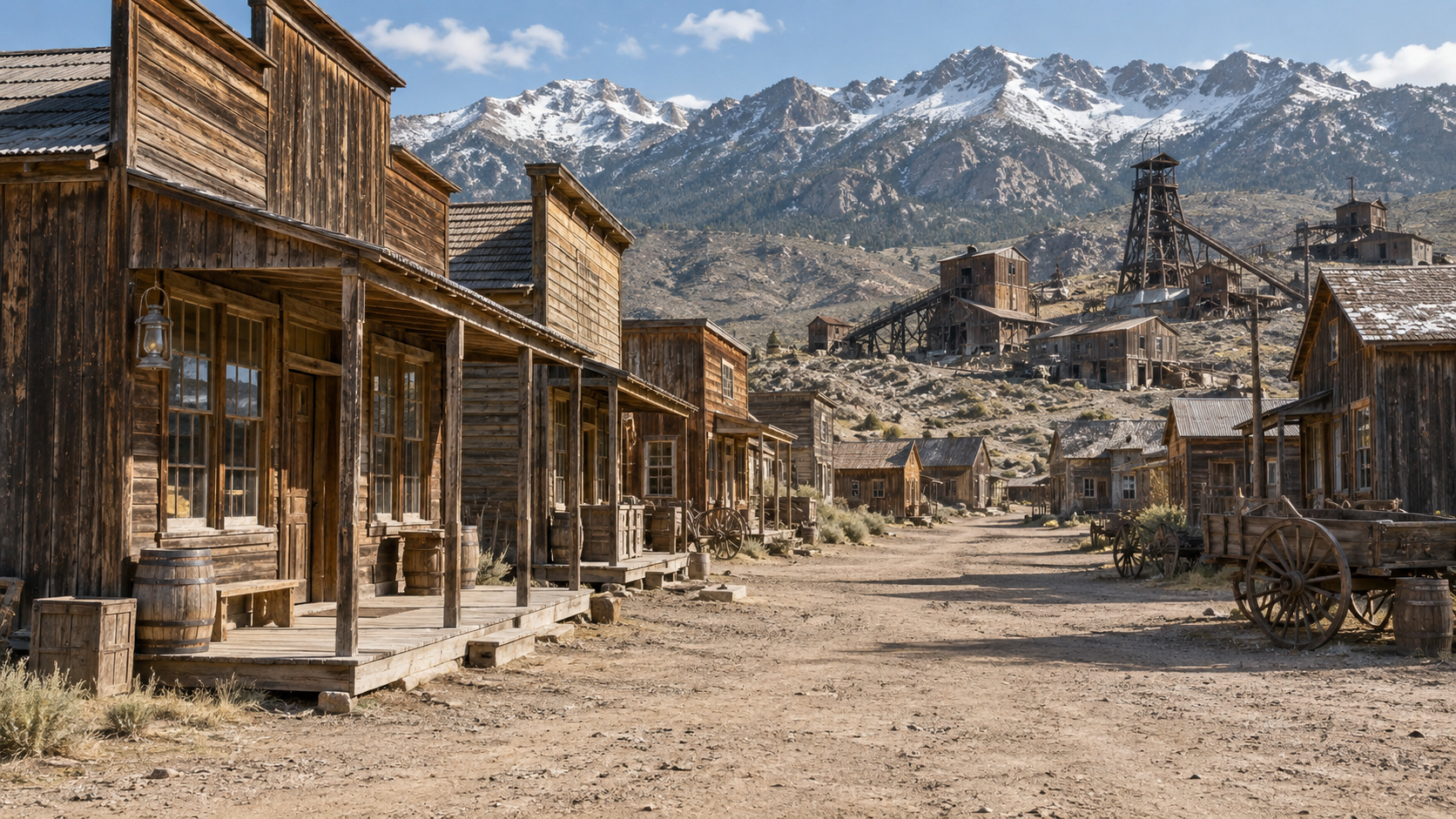
Source-led question: How did a California mining town become one of the West's best-preserved ghost towns?
A ghost town can look as if everyone left on the same morning. Bodie, California, tells a slower story. Its weathered buildings, high-elevation streets, and empty windows preserve the trace of a mining town that grew, worked, changed, and gradually lost the reasons that had brought people there. The central question is not simply why Bodie became a ghost town. It is why so much of the town remained visible after the economy moved on. The National Park Service places Bodie at about eight thousand three hundred seventy-nine feet in the Sierra Nevada. That elevation is part of the story. Snow, cold, wind, and isolation shaped daily life and limited what could be repaired or replaced. A remote town does not decay in the same way as a city connected to regular shipments and expanding roads. Bodie grew around gold mining. People needed stores, machinery, boarding houses, saloons, offices, andThose ordinary systems made the town feel permanent until the mining economy could no longer support them.
What the record supports
- Documented: Bodie sits at roughly 8,379 feet in the Sierra Nevada.
- Documented: The district preserves an unusually large collection of original mining-town buildings.
- Documented: Bodie grew from gold-mining activity and supported a commercial town in a remote setting.
- Documented: The park preserves the town without rebuilding it into a polished reconstruction.
- Inference: Bodie shows how geography, mining economics, and preservation shape what survives.
The episode uses clearly labeled synthetic reconstruction imagery for explanation. Those images are not archival photographs and do not establish that an uncertain detail was witnessed.
The source trail keeps documented facts separate from inference. The episode follows the strongest available records and leaves unresolved parts visible; a missing record is not evidence for a precise route, invented dialogue, recovered object, or modern valuation.
Continue the series
- Western Stories index
- Old West hub
- Continue with the next source trail
- Subscribe to Old West source trails
Sources
- Bodie Historic District — Bodie is described as the best-preserved ghost town from the California Gold Rush at an elevation of 8,379 feet.
- Bodie National Register description — The town's original buildings and isolation make it an unusually complete mining-town example.
- Bodie State Historic Park interpretation — The park preserves Bodie in a state of arrested decay rather than restoring it as a functioning town.
Media note: This page uses an authorized synthetic reconstruction image. The historical claims remain tied to the source links above.
Loading comments…