Source-led question: Why did millions of cattle move north after the Civil War, and who made that market possible?
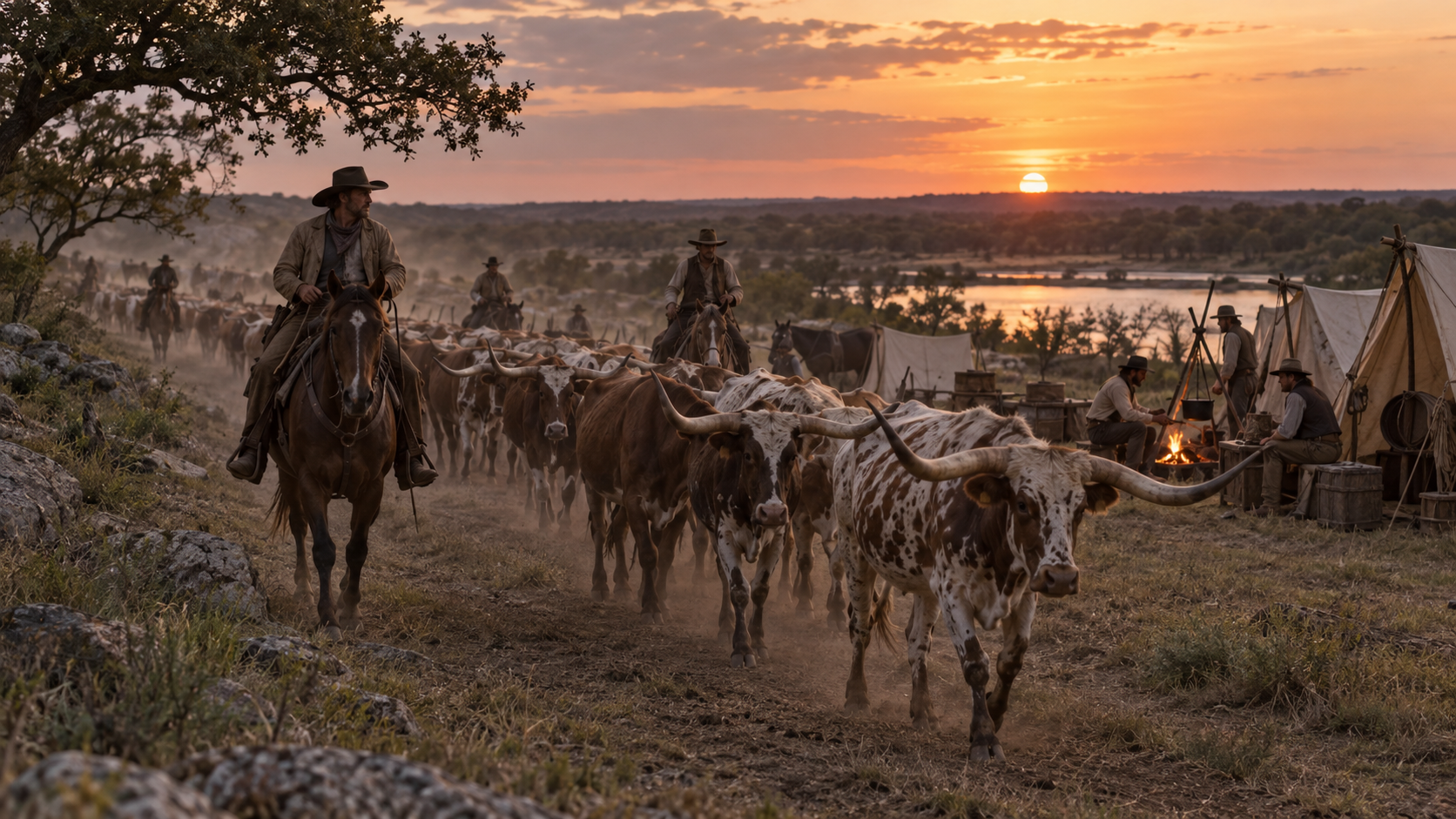
The Chisholm Trail is usually introduced with a familiar image: cowboys, longhorns, dust, and a horizon. The image is real, but it is too small for the market the trail carried. After the Civil War, Texas held huge herds and northern railheads offered access to distant buyers. The trail became a moving connection between animals, labor, railroads, and money. It was a business corridor that happened to move on four legs. The National Park Service study describes upwards of ten million cattle traveling north on the Chisholm and Great Western routes between eighteen sixty-seven and the eighteen eighties. The exact path was not one perfectly marked road. Herds followed water, grass, crossings, and decisions made by people who knew the country. A trail could widen, shift, or split while the market at the end remained the goal. A drive began long before the first cattle reached the trail.A drive began long before the first cattle reached the trail. It depended on breeding, branding, financing, provisioning, and choosing a railhead.
What the record supports
- Documented: Cattle trails moved millions of animals north between 1867 and the 1880s.
- Documented: The drives connected Texas herds with railheads and markets farther north.
- Documented: Cowboys, vaqueros, cooks, horse handlers, and trail bosses made the drives possible.
- Documented: The trail crossed rivers and Indian Territory rather than following an empty cowboy road.
- Inference: Railroads eventually reduced the need to drive herds such long distances.
The episode uses clearly labeled synthetic reconstruction imagery for explanation. Those images are not archival photographs and do not establish that an uncertain detail was witnessed.
The source trail keeps documented facts separate from inference. The episode follows the strongest available records and leaves unresolved parts visible; a missing record is not evidence for a precise route, invented dialogue, recovered object, or modern valuation.
Continue the series
- Western Stories index
- Old West hub
- Continue with the next source trail
- Subscribe to Old West source trails
Sources
- Chisholm and Great Western Trail Feasibility Study — The routes carried upwards of ten million cattle north from Texas between 1867 and the 1880s.
- Texas Cattle Drives — Cowboys and vaqueros moved cattle north and crossed major rivers on the trail.
- Trail Drives — Trail drives moved cattle from a range to a market or railhead, and the trail boss coordinated the drive.
Media note: This page uses an authorized synthetic reconstruction image. The historical claims remain tied to the source links above.
Loading comments…