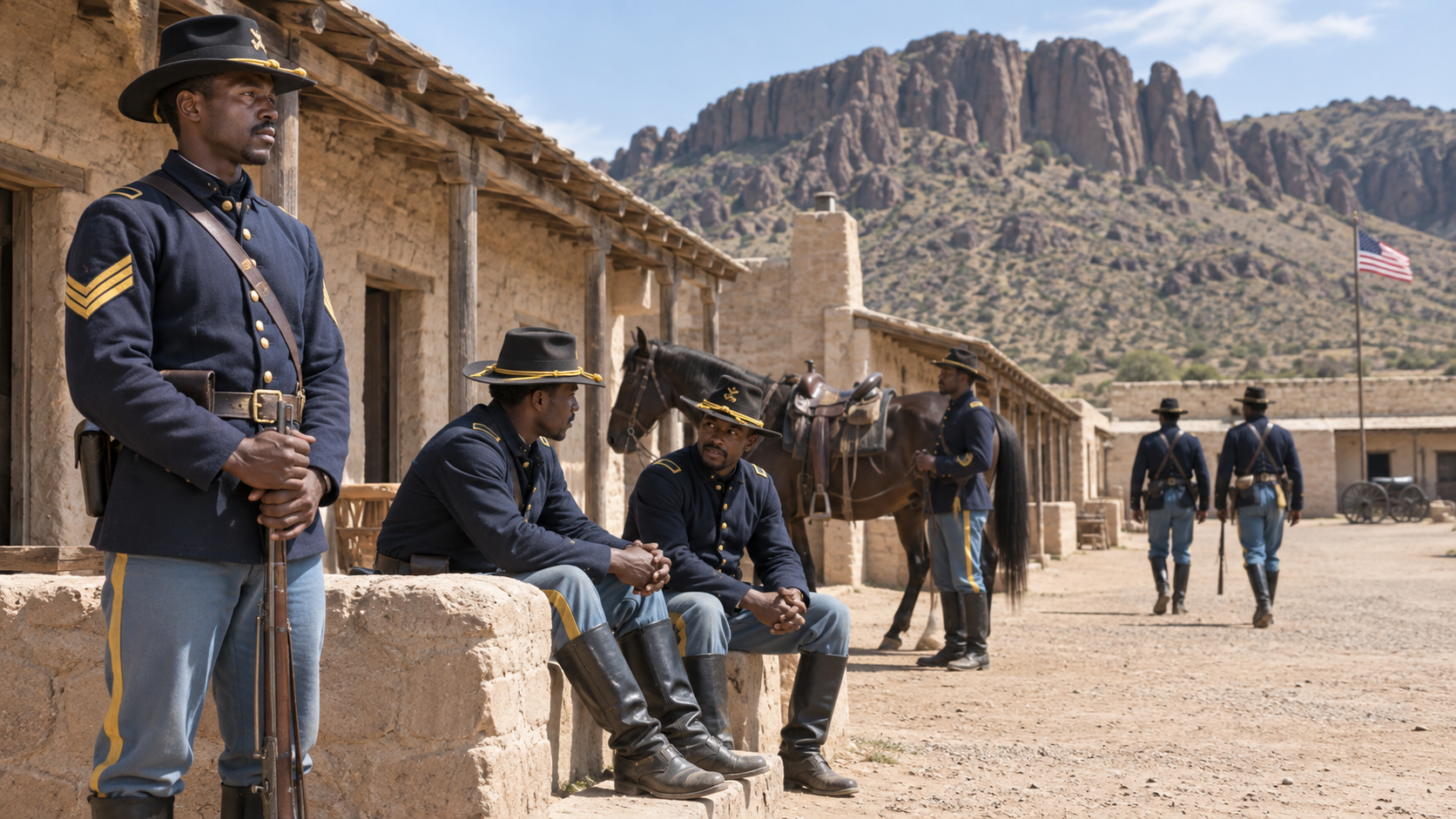
Source-led question: What work did Black Regulars perform at Fort Davis beyond the battles remembered in popular stories?
The phrase Buffalo Soldiers often brings a battle scene to mind. At Fort Davis, the record shows a wider job. Black Regulars guarded roads, escorted mail, built infrastructure, patrolled a huge region, and rebuilt a post in West Texas. Their military service was real, but it was not limited to combat. The fort's history becomes clearer when the work behind the frontier system is placed beside the fights remembered in popular stories. After the Civil War, Congress expanded the regular army and required new cavalry and infantry regiments to be composed of Black enlisted men. The Ninth and Tenth Cavalry and several Black infantry regiments became part of the western military network. Their service took place inside a segregated army, with white officers leading Black enlisted soldiers. The structure of the institution matters as much as the later legend. In eighteen sixty-seven, LieutenantIn eighteen sixty-seven, Lieutenant Colonel Wesley Merritt arrived with companies of the Ninth Cavalry to rebuild the post.
What the record supports
- Documented: The 1866 army reorganization created Black cavalry and infantry regiments.
- Documented: Black Regulars served at Fort Davis from 1867 through 1885.
- Documented: Their duties included protecting travelers, freight, and mail on the San Antonio–El Paso Road.
- Documented: Troops helped build roads and string telegraph wire in West Texas.
- Documented: The term Buffalo Soldiers was later applied broadly to African-American frontier troops, while some historians prefer Black Regulars.
The episode uses clearly labeled synthetic reconstruction imagery for explanation. Those images are not archival photographs and do not establish that an uncertain detail was witnessed.
The source trail keeps documented facts separate from inference. The episode follows the strongest available records and leaves unresolved parts visible; a missing record is not evidence for a precise route, invented dialogue, recovered object, or modern valuation.
Continue the series
- Western Stories index
- Old West hub
- Continue with the next source trail
- Subscribe to Old West source trails
Sources
- Buffalo Soldiers at Fort Davis — The Ninth and Tenth Cavalry and four Black infantry regiments served at Fort Davis between 1867 and 1885.
- The Second Fort Davis: 1867–1891 — Lieutenant Colonel Wesley Merritt arrived in 1867 with four companies of the Ninth U.S. Cavalry to rebuild the fort.
- Texas: Fort Davis National Historic Site — African-American troops protected travelers, freight wagons, and mail coaches and helped string telegraph wire.
Media note: This page uses an authorized synthetic reconstruction image. The historical claims remain tied to the source links above.
Loading comments…