The horses came back without riders
The horses were borrowed from the Roberts ranch for a ride toward the mine. When they returned without James Cooney and the man called Chick, the people waiting along the San Francisco River had to understand what the animals were telling them. Agnes Meader Snyder remembered blood on the horses and an alarm moving from one household to the next. A mining camp had been attacked in the hills. The danger was now close enough that the Meaders had to choose a place to shelter.
Their neighbor’s house stood near the river in the settlement later called Alma. Agnes described a long log building with a door at each end. By the time her family reached it, other valley residents had gathered there. The house belonged to a Roberts family, whose members would help shelter dozens of people through a day of gunfire. The scene comes to us chiefly through Agnes’s account, recorded in 1937, but the mine historian Fayette A. Jones wrote a different chronology in 1904, and men traveling with Captain Madden left dated reports in May 1880. Read together, the accounts give the day a beginning, an aftermath, and a family home at its center.
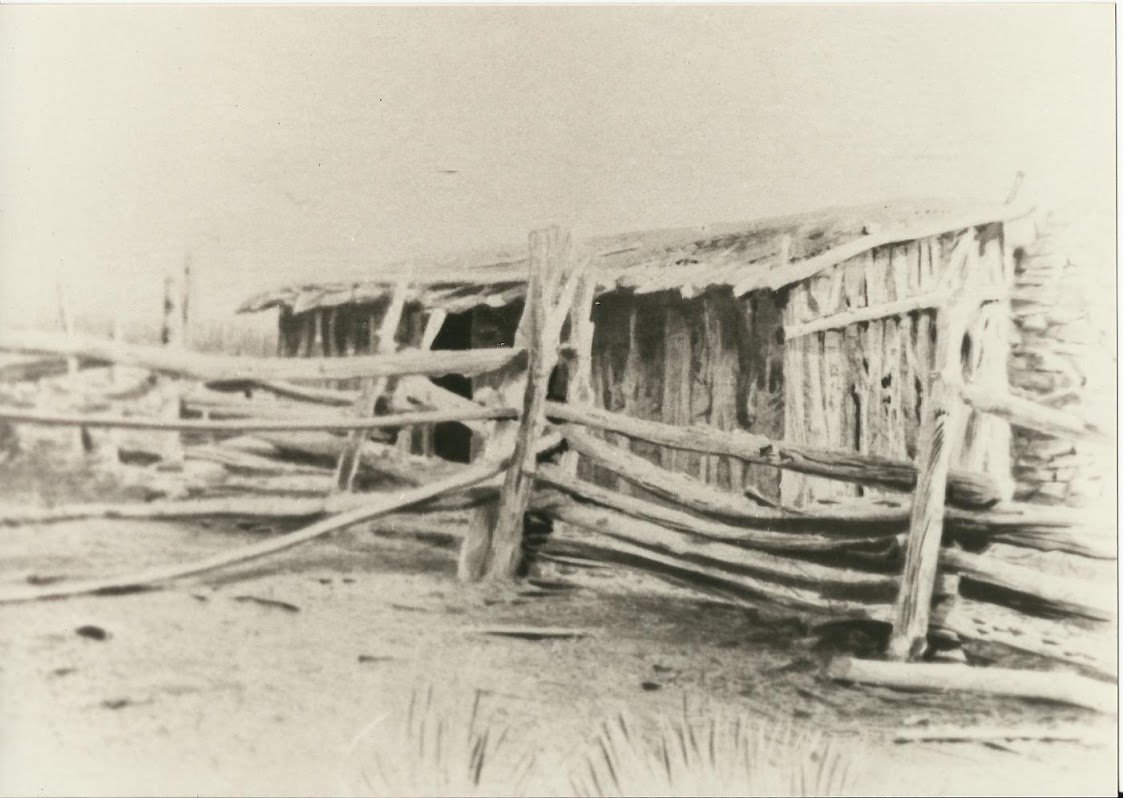
The Roberts cabin in a photograph supplied by Randy Salars. The same image appeared in Desert Magazine in 1944, identified there as an older photograph from Agnes Meader Snyder’s collection. Its original date is unknown.
The house did not stand alone in empty country. Mineral Creek climbed toward Cooney’s silver workings. The river valley held ranches, sheep operations, a store, fields, and families living far enough apart that a warning could reach one door before another. For the Chihenne, or Warm Springs Apache, this was part of a homeland reshaped by federal removal and war. For the Meaders and Robertses, it was also a place of daily work: stock to feed, crops to raise, tools to keep, and children to protect. Those different histories met violently in the last days of April 1880.
Before the warning
Agnes’s family had come west from Sherman, Texas, in 1879, intending to reach Arizona. Weather and news of a relative working in the Frisco country altered their route. They settled in the valley. Agnes later said they were the third family there. That number may have referred to the recent settler households she had in mind, rather than every family or worker living in the wider valley. It is a measure of how young and exposed her family’s particular community felt, not a census of a landscape that already had Apache homelands, Mexican stock operations, and travel routes.
The Meaders had a lean-to and slept partly in their wagon. They worked with mules. Agnes remembered a store across the creek, a corral, a crop her father hoped to raise, and the Roberts ranch close enough for a rider to carry a warning. These ordinary details matter. They explain why a decision to leave a house was also a decision about stock, food, tools, and the possibility of a season’s labor lost. The families did not know they were characters in a later historical episode. They were trying to make a living in a place where news took time to travel and a neighbor’s arrival could change the day’s plans.
To the Chihenne, or Warm Springs Apache, this was homeland rather than a newly opened frontier. Federal policy had removed Warm Springs families from Ojo Caliente to San Carlos in 1877. Victorio and his followers resisted the removal and the prospect of renewed confinement. Their war moved across New Mexico, Arizona, Texas, and northern Mexico. The National Park Service describes a fourteen-month struggle after Victorio left the reservation system in 1879. Understanding that history explains the conflict’s setting. It does not make the killing of miners, herders, or other civilians less real. Both the campaign against Apache families and the violence against valley residents belong in the account.
In Agnes’s telling, sheepmen in the hills resented new settlers and told Apache fighters that those settlers would be easy to attack. This is an allegation preserved in her interview, not a documented explanation of what Victorio’s men intended. Agnes was describing what she had heard or believed decades later. There is no identified sheepman’s testimony in her account, no recorded conversation with Victorio, and no basis for treating the allegation as a collective act by Mexican workers. It is particularly important not to turn the story into one in which the reported deaths of Mexican herders are explained away by an unverified accusation against them.
The mine in the hills
In the last days of April 1880, an Apache force associated in the sources with Victorio attacked the Cooney mine near Mineral Creek. Agnes recalled that the miners had nearly finished work for the day. She said three men were killed there, another man named Taylor was wounded in the leg and hid in a cave, and others scattered. The mine attack was the first event in the sequence she told in 1937. A 1904 mining history by Fayette A. Jones instead names two initial dead, including a miner called Buhlman, and says George Williams and the wounded James Taylor escaped to warn the valley. A regional history published in 1907 gives a wider April 28–30 span for the fights. The familiar single date, April 28, marks the opening of the episode in many summaries; it should not compress the following night, rides, siege, and relief into one moment.
The noise Agnes heard after dark did not initially announce itself as a warning. Her family thought it might be frogs near the marshy ground. She thought it came from the hills. Later, she said, she learned that Cooney and a companion called Chick had hidden after the mine attack. In the dark they made noises to set dogs barking and help them find their way down. This is one of the account’s most memorable turns: a sound carried across the valley, heard by a young person who could not yet know its source, became meaningful only when the men arrived.
Agnes waited in the wagon, listening. She heard voices from the direction of the Roberts house and thought someone there might be ill. Then a rider reached the Meader place. He asked for her father and said Apache fighters were nearby. He urged the family to bring the stock in and prepare, because he had to continue warning others. Her father gathered animals and fetched relatives sleeping at the store. Agnes and her mother began making bullets. The interview gives the family a series of decisions rather than a single instant of panic: wake the house, gather people, secure animals, make ammunition, assess whether to stay.
Cooney and Chick came down from the hills. Agnes remembered Cooney saying that the attackers would probably take property at the mine and leave the settlers alone. The family trusted his experience as a former Army scout enough to keep working, even to laugh as they made bullets. In retrospect his judgment appears tragically wrong. But the scene also shows why people stayed in an exposed valley after hearing of the mine attack. They had information, a neighbor with experience, and no certainty that the danger would come to them.
The next morning Chick wanted to go back toward the mine. Cooney resisted, according to Agnes, then agreed rather than let him go alone. They borrowed horses from the Roberts ranch; the Meaders had mules rather than riding horses. After a wait, the horses came back without riders and with blood on them. Those details were enough for people in the valley to understand that the danger had not ended in the hills. Agnes said two men, Potter and another whose name the interview records uncertainly as Motsiner, rode out to learn what had happened. They too encountered the attackers; Potter returned after his gun was hit and his arm hurt. Cooney and Chick did not return. Jones’s 1904 history gives the rides a different order and places Cooney’s death after the ranch attack. The surviving accounts agree on the alarm, the attack on the refuge, and Cooney’s death, but they cannot give us a single exact sequence for every ride. Agnes’s remembered path remains the best guide to what the Meaders experienced on their way to the house.
The story of James Cooney’s death became attached to the rock tomb later cut for him along Mineral Creek. Tombs make an individual visible in a way that a dispersed group of dead often is not. Cooney’s name survived in the mine, the canyon, and local history. The Meader interview also remembers unnamed miners, stock workers, and families. The next chapters of this series follow the people outside the ranch house whose names were less likely to be preserved.
Which shelter?
When the riderless horses returned, the Roberts family sent another warning to the Meaders, Agnes recalled. Her parents disagreed about where to defend themselves. Her father preferred their own place because it stood on open ground. The Roberts house, he believed, lay below a hill from which attackers could fire down. Her mother insisted that they go to the ranch where others were assembling. The disagreement was practical. A house with a poor position might still offer stronger walls, more defenders, and a chance to keep families together. An isolated lean-to might offer a better view yet leave too few people to protect it.
They put two white mules to the wagon. A son stayed at the corral with stock. The separation gives this episode its human scale. A family under threat did not move as a single safe unit from one house to another. One person remained behind because animals could be a household’s means of survival. Others took the road. People at the Roberts ranch watched for them. Every choice placed someone in a different patch of ground with a different view of the approach.
On a rise, the Meaders saw cattle staring into the distance. Agnes’s mother believed the animals were watching attackers. Her father initially said the cattle were watching the wagon. Then the animals ran and shots came. The remembered conversation captures how quickly ordinary reading of the landscape changed into alarm. Agnes grabbed an old Springfield rifle and discovered that it was unloaded. The cartridges were in her father’s stiff new belt; the wagon bounced too hard for her to pull one free. She pointed the empty gun outward anyway as her father drove faster and the others lay down.
Agnes could later describe the scene because she survived it. That fact can make the ride sound inevitable in hindsight. It was not. She recalled bullets passing the wagon, the people at the Roberts place seeing the danger, and six men riding out between the wagon and its pursuers. Their action drew fire and gave the Meaders time to reach the buildings. The 1937 interview does not identify all six riders, so the scene should not be turned into a roster invented from later legend. It does show neighbors exposing themselves to protect a family whose wagon was still in the open.
The wagon stopped behind a log shed. One mule fell dead just as they arrived. The family took shelter by a wall; a shot passed close to Agnes’s sister when she looked around a corner. To reach the main house they had to cross a ditch. The interview remembers this crossing because danger did not end when the wagon stopped. The yard, shed, ditch, doorway, and inner room each offered a different degree of cover. At the moment the firing eased, family members moved across and into the building.
Inside, beds had been arranged around the walls and women and children placed toward the center. Agnes estimated thirty-one men in the house in addition to six members of the Colter family, five of the Roberts family, and six of her own. Her categories are not a modern attendance sheet; they do not name every person or clarify whether all counted adults were armed. But they establish the scale of the refuge. The Roberts home had become a shared defensive space for dozens of people. Its capacity, walls, and occupants mattered to the fate of more than one family.
The long day
Agnes described a sustained exchange of gunfire around the house. Her account counted Apache riders circling in groups, firing and drawing back. She also gave a precise total of 213 attackers. That total cannot be checked from the interview and should be treated as her recollection, not an exact head count. People under fire could see only parts of a moving landscape. Nor can the interview alone establish every wound or death among the attackers. Its strongest evidence is for what Agnes said happened in and around the house: a prolonged defense, little freedom of movement, shrinking ammunition, and fear that an assault might break through.
Inside, the arrangements made at the start of the attack became difficult to maintain. Food and milk were across the room. Children became hungry. Agnes recalled wanting to move from the center to help near a cupboard and asked Mrs. Roberts whether milk was there. That small exchange is among the few moments in the archival narrative in which a Roberts family member appears as an individual actor. Mrs. Roberts answered a question about feeding children while armed people watched the approaches. The moment is neither a dramatic charge nor an order from a commander. It is a household act performed under siege.
Agnes crossed the room for the milk. A man called Wilcox warned her to move quickly on the way back because bullets were finding every movement through gaps in the wall. He then saw his business partner trying to reach the house and went to the doorway to help cover him. Agnes recalled hearing Wilcox cry out that he had been shot just as she handed the milk to a child. He set down his gun, moved toward the fireplace, and died. Fayette A. Jones’s 1904 mining history names him William Wilcox and places his death at the Roberts ranch on April 29. This is one of the few deaths at the refuge for which the eyewitness scene and an earlier printed name can be joined. It also shows the terrible closeness of everyday need and mortal danger: milk reached a child in the same interval that a defender lost his life.
Other people in the interview have the same mixture of ordinary purpose and extraordinary risk. Men fired from the house, watched the ditch, and tried to bring someone named Murray inside. Agnes remembered a man called Foster who understood Apache speech and signs and warned defenders to conserve ammunition. The interview is our source for those details; it does not independently verify Foster’s translations of distant commands. It does show the defenders’ fear of being overrun and the practical need to make each shot count.
Water was another immediate concern. Agnes remembered a ditch outside the house—the one her family had crossed on the way in—and said the people inside filled containers because they feared losing its flow. Irrigation had made farms possible along the river; under fire, its ordinary channel became a point of survival. The 1944 magazine version has women carrying water from a nearby ditch, but the older interview does not assign that errand to specific people.
By late day the attackers had moved away from the house. Agnes said they made a camp in the area of present-day Alma and that defenders fired toward them when the noise grew close. She interpreted the withdrawal as a reluctance to fight after dark. That explanation reflects her understanding, not an authenticated statement of Apache plans. The people in the house could observe that firing slackened; they could not know exactly why a force chose to move or whether it would return at first light.
Two men left to seek help at Silver City. Agnes believed they would have to pass close to the attackers’ camp. The farewell in her telling is understated: the men said goodbye, and those in the house did not expect to see them again. Their ride carried the valley’s emergency outward. They found new mounts along the road and delivered the alarm, Agnes said. News that had begun with a rider waking one family now had to reach a fort and return as a relief column.
The night did not erase the day’s dead or guarantee morning. The household remained assembled. Ammunition and food were finite. The animals outside were vulnerable. Agnes later said seventeen head of stock in the Roberts corral were killed while one of the Meaders’ white mules survived near the house. Whether those figures are complete cannot be independently established here, but they explain why survival was followed by economic loss. A ranch might stand, the people inside might live, and its ability to work the next day might be badly damaged.
The people who came, and those who did not
Agnes remembered a Captain Madden arriving with soldiers on the second morning after the fight. In her account, he looked through field glasses, saw people alive at the ranch, and called out that they had come in time. Madden’s dated report, however, places his arrival at the upper settlement on May 5, after riding from Silver City on May 4. If the ranch fight occurred April 29, as Jones wrote, Madden reached the area nearly a week later. Agnes may have compressed the interval, remembered another relief party as Madden’s, or dated the fight differently. The available records do not choose among those possibilities. The soldiers were not present for the wagon’s dash into the house or the defense that followed; the dated military account anchors when Madden reached the settlement.
Her interview reported that Apache fighters moving away killed thirty-five Mexican sheepherders. That number has traveled into many retellings and then been added to other reported deaths to produce the familiar figure of forty-one. Yet the original passage gives no list of names, locations, death records, or witness accounts from those herding families. Later sources differ sharply: a modern New Mexico Magazine story speaks of about a dozen miners, herders, and settlers killed over the episode. The appropriate conclusion is not that the herders can be forgotten, nor that thirty-five is established beyond doubt. It is that their deaths require more careful naming and verification than the most repeated number has received.
What the first reports recorded
A surviving May 3 military telegram from Fort Bayard relayed news that the Cooney camp had been attacked. Captain Humphreys called his information seemingly correct, an honest sign that he had not yet reached the scene. The reported dead were Buhlman and a man whose surname is uncertain in the surviving transcription; Cooney and Chick were listed as supposed dead, while Taylor, Potter, and Murray were reported wounded. The message estimated forty or fifty Apache fighters, two killed, and eighteen head of stock taken. These are early reported numbers, not a final field investigation. They differ from Agnes’s later estimate of 213 fighters and from later lists of the dead.
The archive also preserves George W. Helde’s diary, printed by the Grant County Herald on May 22. Helde rode with Madden’s party. He dated its departure from Silver City to May 4, arrival in the upper Frisco settlement to May 5, burial of Cooney, Chick, and Buhlman to May 6, and discovery of four Mexican herders’ bodies on May 7. His dated trail gives the story a second witness to the aftermath, though he did not say he saw the ranch fight itself. Madden’s May 26 report follows much the same route. He wrote that his party found four dead sheep herders and eight people killed at a ranch farther up the Frisco: two men, two women, and four children. Those eight were victims of the wider pursuit, not people he identified as having died inside the Roberts refuge. Neither report supports simply adding every body encountered along the trail to an April 29 ranch total.
The early papers do not erase Agnes’s experience. They let us distinguish the attack she survived from later deaths along the route, and what a warning officer believed on May 3 from what a burial party knew on May 6. The Silver City Enterprise began publication in 1882, so its later reprint books can preserve retrospectives but cannot supply an issue written during the April 1880 fighting. For contemporary local reporting, the Grant County Herald diary and the military correspondence are closer to the event.
Agnes also relayed a claim that the attackers carried away nine dead of their own. The basis offered was a reported captive’s statement. A 1944 magazine retelling later gave another explanation involving nine pairs of moccasins. Those are different evidentiary claims. Neither supplies a verified list of Apache casualties. More seriously, the 1937 interview contains assertions about Apache scouts and an account of a scout being hanged by settlers sometime afterward. These passages are part of the historical document. They should be read critically: the interview records Agnes’s memory and the hostile language of a period, not a neutral finding about Apache people as a whole, and the reported hanging is a killing that deserves scrutiny rather than casual repetition.
Agnes said her family returned to find its belongings gone. Her father sent the children toward Silver City with Sheriff Whitehill. The family had survived but had to resume life with fewer resources and new fears. The Roberts family had also lost stock. We do not yet have a Roberts family diary describing the following days, the repairs to the house, or how its children remembered the attack. The absence of that account should remain visible. Agnes’s voice brings us close to the ranch; it does not become the private voice of everyone who sheltered there.
What the name “massacre” holds
The name “Alma Massacre” later gathered several violent encounters into one phrase. It included deaths at a mine and along the river, while the Roberts house was where a crowd survived. The often repeated forty-one-death figure does not describe people killed inside that building. In Agnes’s recollection, the house was the refuge where many survived. The episode stretched from the mine and trails to the wagon road, ranch, sheep country, and the ride for help. Its geography is one reason casualty totals and dates can be confused in condensed histories.
The name also entered a larger war. The Warm Springs Apache experience did not begin with the mine attack. Removal from Ojo Caliente, the return of families, the threat of further transfer, Army pursuit, and fighting across a wide borderland preceded these days in the Frisco Valley. The victims at the mine and among the herders did not deserve death because of federal policy. Apache families did not forfeit their history because some warriors attacked civilians. A truthful account holds both parts of the country in view and avoids turning either population into scenery for the other’s suffering.
The Roberts household was not an anonymous backdrop. Agnes counted five members of that family inside and remembered Mrs. Roberts answering her about milk for a child. Randy Salars, a descendant of the family, has since supplied photographs of the house and an older Roberts generation. His grandmother Sarah Ellen Roberts Salars was born in 1894, so she was not herself at the attack. The family tree names her father as George W. Roberts, who was a young man in 1880, and her paternal grandparents as Josiah and Sarah E. McCready Roberts. Those older adults are a plausible connection to the defended home, but no account yet examined names the five Roberts people who were inside. The family portrait and record trail receive a close reading in the third chapter.
The wagon reached the house. The door closed behind another family. Food had to be found for a child. Someone watched the ditch; someone counted cartridges; two men prepared to ride out through the dark. Those acts are not legend. They are the substance of Agnes Meader Snyder’s surviving account, and they give the Roberts family’s home its rightful place in the history of Alma.
Sources and reading notes
- Frances E. Totty, “The Alma Massacre,” Federal Writers’ Project, December 3, 1937, Library of Congress. The original digitized manuscript preserves Agnes Meader Snyder’s first-person recollection. It was recorded about fifty-seven years after the events. Ages, counts, speech, and precise sequence therefore need cautious treatment.
- Fayette A. Jones, New Mexico Mines and Minerals, 1904, pp. 130–132. Names Buhlman, George Williams, James Taylor, William Wilcox, Al Potter, and John Motsinger; provides a chronology that conflicts with the later Agnes interview; and records a date dispute involving Cooney’s tomb and a Mr. Meeder who survived the siege.
- National Park Service, “Warm Springs Apache”. Background on Chihenne homelands, removal to San Carlos, Victorio’s campaign, and the fate of families afterward.
- Betty Woods, “She Defied Victorio With an Empty Rifle,” Desert Magazine, March 1944, pp. 10–12. A later interview and dramatic retelling involving Agnes Meader Snyder. Page 12 prints the same Roberts cabin image supplied by the family, describing it as an old photograph from Snyder’s collection. Its description of the house as adobe differs from the log building in the 1937 manuscript; its staged scenes are not adopted as verbatim testimony.
- History of New Mexico: Its Resources and People, vol. 2, 1907, p. 962. A regional account that dates a series of fights on Mineral Creek and nearby between April 28 and 30, 1880. It focuses on the mine and Cooney rather than providing a full roster of valley casualties.
- New Mexico Magazine, “Explore Mogollón, New Mexico’s Ghost Town in the Gila Wilderness”. A recent retelling useful for comparison because its casualty description differs from the widely repeated forty-one.
- Robert N. Watt, Horses Worn to Mere Shadows, online annex of original documents, pp. 105–110. Transcribes Captain Humphreys’s May 3 telegram, George W. Helde’s diary printed in the Grant County Herald on May 22, and Captain Madden’s May 26 report, with archival citations to National Archives military records.
- Silver City Public Library newspaper finding aid. Lists the Silver City Enterprise starting November 1882, after the Alma events.
- Roberts family tree and Ancestry gallery comment on the family portrait. Descendant-maintained genealogy and later proposed photo identifications; tree duplicates and the undated print limit certainty.
Continue with the lives beyond the house and Agnes’s oral history and Roberts family memory. Read the wider Victorio history and the site’s Apache Wars historical fiction cycle for clearly labeled narrative perspectives.
Loading comments…