Seven people before a fence
The family photograph shows seven people standing in open country before a rough fence. At the far right is an older man holding a long gun. Beside him stands an older woman. Near the center are two younger men with guns, a small boy, a young girl, and a woman at the left. It is tempting to look at the weapons and declare the picture a roll call of the people who defended the Roberts house near Alma in 1880. The photograph says something more grounded and, in its way, more moving: this was a family worth remembering together after the danger had passed.
Randy Salars supplied the image from his Roberts family line. An Ancestry comment on the same photograph, posted long after the picture was made, proposes the names from left to right: Melvina “Mellie” Roberts, George Washington Roberts, William Grant Roberts, Joseph Roberts, Sarah Elizabeth Roberts, their mother Sarah E. McCready Roberts, and their father Josiah Roberts. Randy remembers the older man’s name as “Joesire,” a form that plausibly points to Josiah. The tree calls him Josiah J. Roberts; a later Day-family sketch calls the older relative Joseph. The names are not perfectly stable across records, but the generation is clear. George is one of the younger men, not the father at the right.
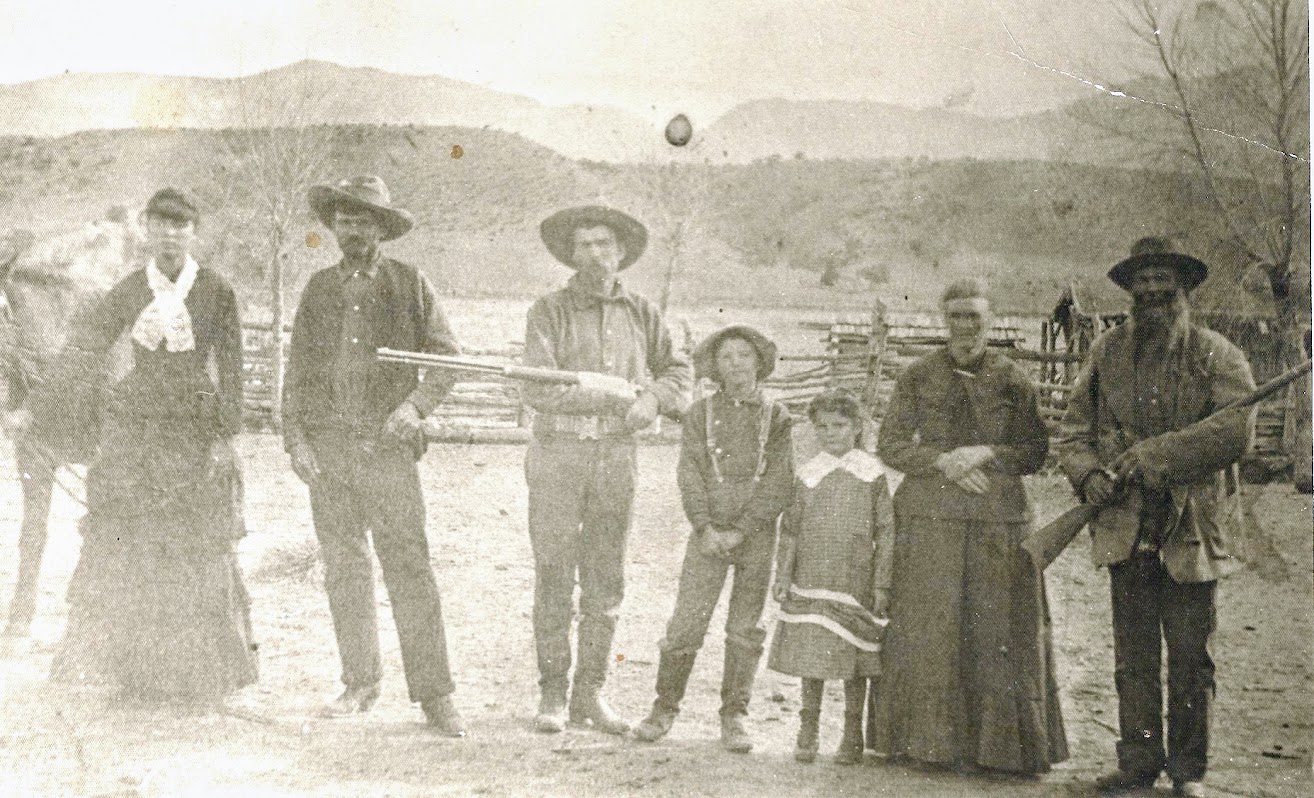
Roberts family photograph supplied by Randy Salars. The left-to-right names are attributed to a later Ancestry gallery comment, not a label on the original print. A comparison with the 1880 census and family tree suggests an early-1880s family portrait. The two guns visible in the image do not identify anyone as a cabin defender.
This portrait gives the Alma story a face, but its date and purpose remain unknown. The family tree’s approximate ages and the gallery comment place the small children and young adults in roughly the early 1880s. If that estimate is right, the shutter opened after the April 1880 attack. The camera did not record the fighting. It recorded a household continuing to live, and perhaps choosing to stand together for a rare photograph. That distinction lets the picture speak without making it prove an event it did not depict.
The older Roberts household
The records arrange themselves into two generations. Randy’s grandmother was Sarah Ellen Roberts Salars, born in 1894. Her parents in the family tree were George Washington Roberts, born in 1861, and Lydia Adeline Clark, born in 1877. In April 1880, George was a young man and Lydia was a small child. Sarah herself would not be born for fourteen years. A story that places George and Lydia as the adult husband and wife managing the cabin during the attack therefore cannot fit these dates.
The older pair in the portrait is the better family lead. The 1880 census household indexed under Josiah Roberts lists him with wife Sarah E. and children including Grant, Melvina, Joseph, and a younger Sarah. It also includes Eliza Jane Day and relatives in a larger household. The census is a snapshot made after the attack in the Silver City enumeration district. It documents kinship and residence in the district; it does not identify the five Roberts people whom Agnes Meader Snyder later counted inside the defended house.
The photograph’s seven proposed names fit that household better than a portrait of George’s later children. Melvina, born about 1868, appears as the young woman at left. George, born in 1861, and William Grant, born about 1864, are the two older sons in the middle. Joseph, born about 1876, is the little boy; the younger Sarah E., born about 1878 or 1879, is the girl. Sarah E. McCready and Josiah are the two adults at right. A person judging ages from faded faces cannot assign the exact year. The pattern of adult sons and young children nevertheless places the image in the right generation and explains why George looks like a young man while the older male at the edge is his father.
Some details resist a tidy caption. The family tree gives Josiah a birth year of 1835, while the census calls him about fifty in 1880, implying about 1830. The tree gives more than one entry for Grant and for some of his siblings, with inconsistent years; the census names one Grant in the household, not two young men of that name. The gallery comment calls the older woman “Sarah Elizabeth McCready Roberts”; the tree calls her Sarah Ellen McCready or McReady, and the census simply Sarah E. We therefore use Sarah E. McCready Roberts when precision matters. The younger girl Sarah E. Roberts is George’s sister. She must not be confused with George’s daughter Sarah Ellen Roberts Salars, who was born in 1894 and became Randy’s grandmother.
A separate family sketch in Arizona Pioneer Biographies, page 115, says Ezekiel and Eliza June Roberts Day moved to Alma and Cooney in 1879. It calls the older Roberts pair Joseph and Sarah Elizabeth “McGrady,” variant forms that may reflect memory, spelling, or a different transcription. The Days appear with Roberts relatives in the census. The sketch helps place this wider kin group in the Frisco country before the attack, but it does not name the owners of the defended cabin. It makes the Josiah–Sarah generation a historically plausible household to investigate, not a proven five-person roster.
Who was inside when the shots came?
Agnes is the witness who brings the family into the room. Her 1937 life history says that five Roberts family members sheltered inside. She describes the house, the crowded beds, a ditch just outside, and a moment when “Mrs. Roberts” answered her question about milk for hungry children. She does not give Mrs. Roberts’s first name or name the other four Roberts people. Fayette A. Jones’s 1904 mining history locates the refuge at Roberts ranch but also does not provide a family roster. The May 1880 military reports trace the dead and the rescue route, not the occupants of the house.
The older couple are reasonable candidates for Mr. and Mrs. Roberts because the family tree and census place them in the right generation, and the Day account connects their relatives to Alma. George, a young adult in 1880, could also have been there. Grant, Melvina, Joseph, and the younger Sarah were living relatives who might have been in or near the house. Yet five is fewer than the seven people shown in the later portrait, and the census includes more relatives besides. We cannot choose the five simply by selecting the faces that look old enough to remember a fight. The family could have been divided among houses, fields, camps, or other settlements that day. The records examined here leave the exact list unresolved.
A second family possibility needs to be placed on the same timeline. Randy remembers that a Lizzie Roberts might have been killed and buried at Cooney’s Tomb. George had a daughter called Lizzie, born about 1892; she cannot be an 1880 casualty. The tree also contains an older Elizabeth or Lizzie associated with Josiah’s children, and the identities in that branch are duplicated. A transcription of tomb inscriptions currently available does not name a Roberts or Lizzie, though an incomplete list cannot rule out an unmarked burial. No death record, contemporary newspaper notice, or identified grave examined for this series confirms a Roberts daughter killed at the house. The possibility remains a family question, not a death we can put into the narrative as fact.
That is as far as the family can be sorted from the current documents. Josiah and Sarah E. are the likely older pair behind the family memory; George is one of their young sons and later Sarah Ellen Roberts Salars’s father. Lydia belongs to George’s later marriage, and the grandmother Sarah belongs to the next generation. The five people at the cabin cannot be individually named from the surviving Agnes, Jones, census, or photo record. A land record naming the cabin owner, a dated contemporary family letter, or another witness who names the Roberts occupants would change that answer. Until then the family portrait should be captioned as a plausible identification of seven relatives, not as a photograph of five proven defenders.
The interview that survived
The Library of Congress catalogs Totty’s manuscript as “The Alma Massacre,” dated December 3, 1937, among the Federal Writers’ Project life histories. The digitized pages are available to anyone who wants to read Agnes’s words in their original sequence. The document is longer and stranger than the capsule summaries drawn from it. It starts in Sherman, Texas, on September 22, 1879, and passes through Deming and Silver City before Agnes’s family settles near Alma. It ends with property loss, a reported hanging of an Apache scout, disputes with an official, and the family’s sense that it was left uncompensated. The usual short version stops once cavalry arrives. Agnes did not.
An earlier oral-history fragment lies inside a mining book. In 1904 Fayette A. Jones wrote that a Mr. Meeder, whom he identified as a survivor of the Roberts siege and the keeper of the Dry Creek stage station, insisted James Cooney had died on April 30, 1880. Jones observed that the date on Cooney’s tomb was April 29. The book’s spelling of Meeder differs from Agnes Meader Snyder’s surname, and the passage does not give a first name. It is likely a reference to her father, but the identification should remain an inference until another record confirms it. The footnote is precious because it shows a person from the besieged group disagreeing with a stone inscription within twenty-four years of the event. Memory was contested long before modern writers began comparing online summaries.
Jones’s account also differs from Agnes’s later narrative about the order of rides into the hills. He puts the Roberts attack on April 29, a Potter–Motsinger reconnaissance on April 30, and Cooney’s death later that day; Agnes’s telling puts the riderless horses and Cooney’s death before the wagon dash to Roberts ranch. The difference cannot be repaired by moving a paragraph in one account. Jones spoke from a mining district’s documentary and oral record; Agnes spoke as someone who had been in the Meader household. Neither supplies a minute-by-minute log. This series keeps each version attached to its speaker, and the lead chapter follows Agnes when it narrates the family’s remembered path to the refuge.
She did not place herself outside the action. Her mother and she molded bullets after the first warning. She described the pressure of the wagon ride, the unloaded rifle she could not load while the vehicle bounced, and the moment her family had to leave its cover behind a shed and cross the ditch into the Roberts house. Later she remembered wanting to reach milk for hungry children and to relieve her brother near a cupboard. She spoke of the men who went to Silver City as people whose return was not expected. These passages make the account more than a report of who fired first. They show how people improvised in a room with children, food, water, weapons, and too little certainty.
Agnes’s father emerges through decisions that did not all agree with the family’s. He thought the Meader place easier to defend because it stood on open ground. Her mother wanted the Roberts ranch. On the wagon ride he initially dismissed the cattle’s warning, then drove hard when the threat became clear. After the siege he dealt with the loss of stock and tools. None of these remembered choices should be turned into a verdict on him. They show what it meant to act with incomplete information. He did not know what the reader knows from the end of the story: that the Roberts house would hold.
The Roberts family appears less often as individuals, which is one reason the descendant’s testimony matters. Agnes says the family sent a warning when Cooney’s and Chick’s horses returned. She counts five Roberts family members inside the house. She identifies Mrs. Roberts as the person who answered her question about milk. In the same passage she remembers William Wilcox stepping toward the door to aid another man and dying from a shot as she handed milk to a child. She remembers seventeen animals in the Roberts corral killed. She calls the building a long house of logs, with a door at each end. From these details one can establish a household and its role in the defense. One cannot derive the full names, ages, or later lives of all five people inside.
From life history to magazine scene
Seven years after the federal interview, Desert Magazine published Betty Woods’s account of Agnes, then known to many as Mother Snider. The March 1944 feature is revealing because Agnes was still alive and could speak to another writer. The article places her beside her son Bert, offers a photograph of her, recounts the Roberts siege, and then wanders into memories of local outlaws and Butch Cassidy. It is a portrait of a person whose life did not stop in April 1880. She had children and grandchildren; she was alert to what younger generations were doing during another war. An eyewitness did not remain frozen at the age she had been during the attack.
The magazine account is also a warning against reading polished storytelling as a transcript. It calls the Roberts house a small adobe building, whereas the 1937 manuscript says it was a long log house. The photograph printed in the same 1944 feature shows a long building with visible timber and a possible masonry end, suggesting the two descriptions may each emphasize different materials rather than document two different places. The magazine gives Agnes as nineteen in 1880, while a modern introduction to the 1937 account calls her an early teenager; those different age claims need an independent birth record to resolve. It places dramatic words in several people’s mouths, describes a bullet through Agnes’s sunbonnet, gives a named warning rider, and offers a staged view of Victorio on a white horse signaling from a mesa. Some details may reflect things Agnes said during the 1944 interview, some may be the writer’s arrangement, and some may have grown through repetition. The article does not annotate which is which.
One image in the 1944 feature is labeled Victorio. The Fort Sill Apache Tribe says a portrait widely identified that way is likely not Victorio at all but another Apache leader, Victor of San Carlos. The tribe says it has not identified a photograph of Victorio. The magazine’s caption thus illustrates a broader problem: once an image and a name are printed together, later readers may assume a certainty the descendants of the people depicted do not accept. We have chosen not to reproduce or rely on that portrait in this series. The Roberts photographs receive the same discipline: identify what the family has told us, then stop before assigning unproved dates or names.
The 1944 article also says Agnes remembered nine dead Apache fighters and explains this through nine pairs of moccasins. Her 1937 manuscript instead attributes the figure to a statement by a Mexican prisoner. The number is the same; the described path by which she learned it is different. That is a small but instructive example of how a story changes when it is told for a magazine rather than recorded as a life history. Repeated numbers can appear firmer even when the support underneath them shifts.
The memories that resist a heroic ending
Short tellings usually end with the soldiers arriving at the ranch. Agnes’s manuscript keeps going. The Meaders went home to losses. Her father sought a way to keep making a crop. She describes a scout who appeared at the mining camp wearing Chick’s coat, was captured by local men, and was hanged. She tells of a dispute over the horse taken from him and of a government official who refused to compensate the family. She expresses contempt for troops she thought unable or unwilling to fight. These passages are troubling, but they cannot be removed simply because a cleaner ending would be easier to celebrate.
The reported hanging is especially serious. Agnes’s narrative gives no court record, the man’s name, or testimony from him beyond words she remembered others reporting. It cannot establish guilt for Chick’s death. It does present a claim that settlers killed an Apache man after the battle. The story of Alma therefore cannot be divided neatly into righteous defenders and violent attackers with every later act assigned to one side. Fear, grief, revenge, and power continued after the firing stopped. A full history would seek independent documentation of the hanging and the official response before making a firm claim about its circumstances.
The 1937 manuscript also contains broad accusations against Apache scouts and claims about Apache customs. They reveal Agnes’s beliefs and the climate in which she lived, not the inner lives of all Apache people. The Fort Sill Apache Tribe’s account of Victorio, Nana, Gouyen, and Loco supplies voices about family, leadership, removal, and survival that a settler interview cannot. The National Park Service explains the forced transfer from Ojo Caliente to San Carlos that preceded Victorio’s war. Reading those sources alongside Agnes does not excuse the killings near Alma. It prevents a local attack narrative from swallowing the entire history of a people.
Likewise, reading the herders as people rather than a number changes the final chapter. Agnes reported thirty-five Mexican sheepherders killed after the attackers left the Roberts house. Modern summaries repeat forty-one total deaths, while another recent account describes a substantially smaller tally. We do not have a confirmed roster of the herders in the sources used here. Their absence from the surviving first-person narrative is a challenge to further local history, not a reason to drop them from view. The form of the archive—whose interview was collected, whose name a mining history remembered, whose grave was marked—helped decide whose story later readers would know.
What the photographs carried forward
The cabin photograph and the family portrait traveled by different paths into this history. The first shows the low building behind a rail fence. A copy appeared in the March 1944 Desert Magazine account of Agnes, credited to her collection and called the Roberts cabin. Randy Salars supplied a copy from his family. Its appearance in two lines of preservation strengthens the identification of the building, though neither copy dates the original exposure. The second image comes through the Roberts family and a later comment naming seven relatives. It helps establish the older generation to which George belonged, even though the April 1880 cabin roster remains unnamed.
The shape of the cabin in the photograph should not be forced into one building description. Agnes called it a long log house. Jones wrote of upright small poles, and the 1944 magazine called it adobe while printing a picture with visible timber and an end wall that may be masonry. The building could have had more than one material or changed over time. The photograph preserves the place as it looked on an unknown later day. It does not reveal what each wall was made of during the attack.
Randy’s grandmother Sarah Ellen Roberts Salars was born after the violence. Her connection to the house came through older kin, family storytelling, and images kept across generations. This is an ordinary way history survives. A child inherits a name before she can ask its first owner every question; a grandchild inherits a picture after the adults who could label it have died. The absence of a perfect caption does not make the picture worthless. It makes the work of matching it to a census, a family tree, and contemporary accounts more important.
Agnes carried a different kind of inheritance. Her 1937 account brings the Meaders into the house; the 1944 article shows her still telling the story as an older woman. Her memories preserve milk, beds, an empty rifle, and the relief of seeing help. Jones’s book preserves miners’ names and a dispute over Cooney’s death date. Madden and Helde preserve the search beyond the house. The Roberts photographs preserve the family and the building. None should be made to speak for all the others. Together they tell a fuller history than a single “massacre” paragraph ever could.
Sources and provenance
- Frances E. Totty, “The Alma Massacre,” Federal Writers’ Project, December 3, 1937, Library of Congress. Digitized original of Agnes Meader Snyder’s first-person narrative; the principal source for the siege and Roberts household.
- Fayette A. Jones, New Mexico Mines and Minerals, 1904, pp. 130–132. A nearer account with named casualties, a different event order and description of the cabin, and the footnote citing a Mr. Meeder on the disputed date of Cooney’s death.
- Betty Woods, “She Defied Victorio With an Empty Rifle,” Desert Magazine, March 1944, pp. 10–12. A later interview and magazine reconstruction of Agnes’s experience. Page 12 prints the same cabin image supplied by Sarah Roberts’s family and credits an older photograph from Snyder’s collection; details are compared with the 1937 manuscript rather than assumed to be identical.
- Fort Sill Apache Tribe, “Our Ancestors”. Tribal accounts of Victorio and other ancestors, including the warning that a widely published portrait of Victorio is misidentified.
- National Park Service, “Warm Springs Apache”. The 1877 removal and the campaign’s broader course.
- Roberts family oral account and two photographs supplied by Randy Salars, grandson of Sarah Ellen Roberts Salars, September 2026. His recollection of “Joesire” is compared with the Josiah entry in the family tree and census; it is not treated as an independent cabin roster.
- Roberts family tree and Ancestry gallery comment on the same family photograph. The gallery comment offers the left-to-right names and approximate ages. The tree includes duplicate or inconsistent entries, so these are attributed genealogical leads rather than independently verified birth records.
- 1880 United States census image and household index for Josiah Roberts. The household includes Sarah E., sixteen-year-old Grant, and Day relatives; it is indexed in the Silver City district and does not locate the defended ranch.
- Arizona Pioneer Biographies, volume 5, page 115. Annie Hollimon Traynor’s family sketch connects the Roberts and Day lines to a reported 1879 move to Alma and Cooney, with variant names requiring further verification.
- Robert N. Watt’s annex of May 1880 documents transcribes Captain Madden’s report and George W. Helde’s diary, which anchor the later search and relief dates independently of Agnes’s memory.
- Silver City Public Library’s WNMU local-history papers finding aid, Book 22, p. 82, catalogs R. Morgan Lyman’s 1976 student paper, “The Battle of Robert’s Cabin and The Dry Creek Store, as told by Agnus Snyder.” A local history research article also cites a taped Meader-descendant interview reported in The Glenwood Gazette, November 2009, pp. 14–15. These are promising oral-history leads, but their full texts or recording were not available for this revision; no new scene or family identification here is attributed to them.
Start with the narrative of the Roberts ranch defense, read the people beyond the house, or browse the wider Apache Wars history.
Loading comments…