West of Silver City, in the northern foothills of the Big Burro Mountains, there was once a camp that shipped silver ore so rich it could be sawed into blocks. It was called Black Hawk, then Alhambra, and the district around it took its name from a nearby landmark, Bullard’s Peak. This chapter tells its story on a narrow path: every fact below comes from a source that was checked line by line for the Grant County Atlas, and each paragraph ends with links to the sources it rests on. Where the sources disagree, the disagreement stays in the story. Where they are silent, the story says so.
The sources are of four kinds. The Director of the Mint reported on the district year by year in the 1880s. Federal geologists visited in 1905 and again from 1948 to 1952, when uranium had made the old dumps interesting. Fayette Jones wrote the district up in his 1904 mining handbook, and he alone names the men credited with the find. And the newspapers carried the camp’s daily news, often second-hand: the Silver City papers are not online before July 1892, so much of the 1880s survives as other papers reprinted it. Newspaper items are quoted as what a paper printed, not as settled fact.
A different Black Hawk mine and mill stood at Hanover, across the county, and is no part of this story. And two voices are missing from it. No Apache account of this corner of the Burro Mountains was found, and none by the Mexican and Hispanic miners and freighters who must have worked here. Each part below is also an Atlas page, where every sentence is tied to its checked fact.
The country before the strike
The ground itself
What kind of country is it? Elliot Gillerman and Donald Whitebread of the U.S. Geological Survey mapped the district in the early 1950s and described it plainly. It lies 21 miles by road west of Silver City, in the northeastern foothills of the Big Burro Mountains, between 5,450 and 6,150 feet above the sea. The hillsides carried scattered junipers, scrub oak, small pines and brush, but no trees big enough to use as mine timber. Jones, writing in 1904, placed the district at the north end of the Burro Mountains, as the northern extension of the Burro district. (Sources: Uranium-bearing nickel-cobalt-native…, p. 284; New Mexico Mines and Minerals, p. 54.)
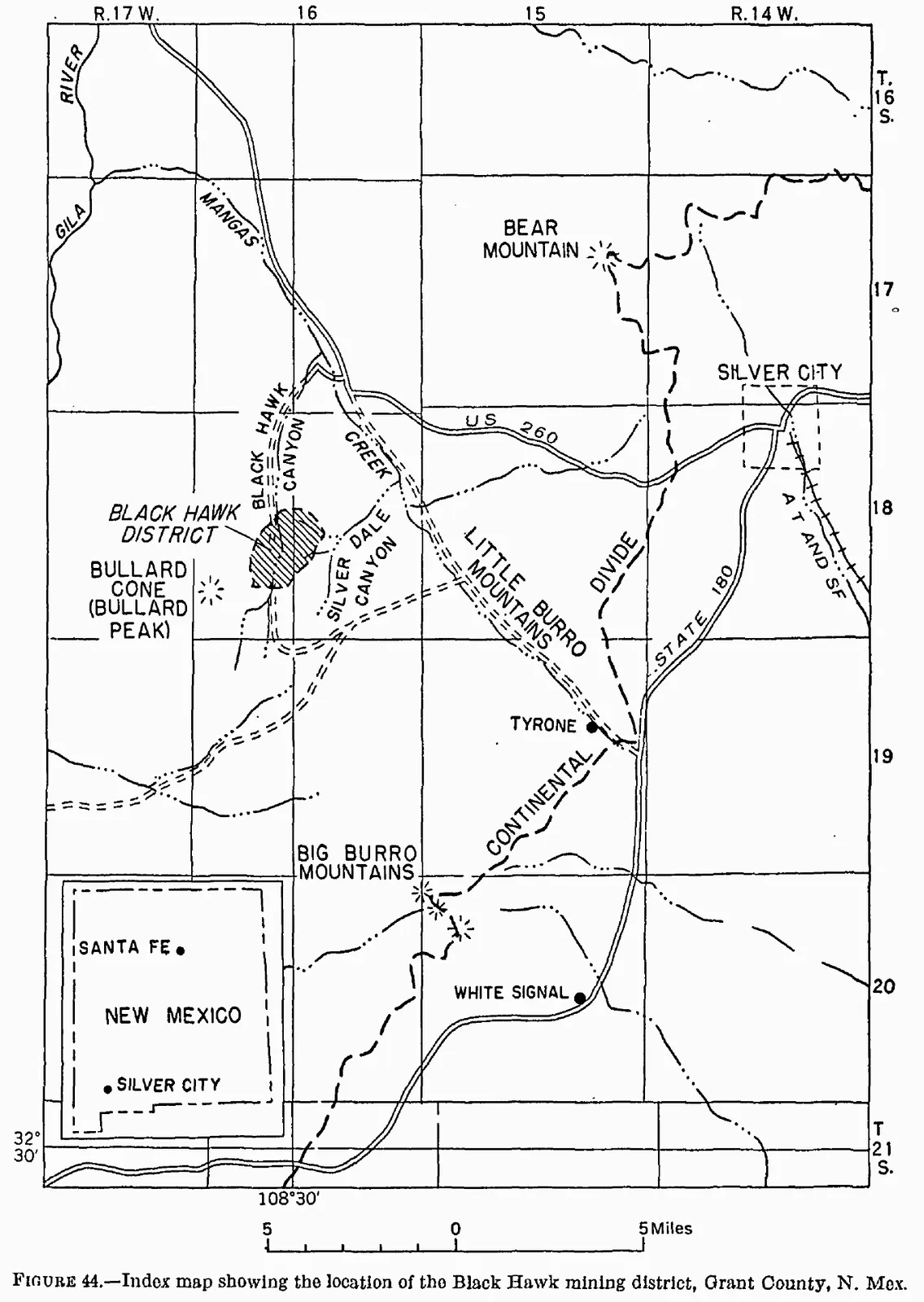
Index map showing the location of the Black Hawk mining district, Grant County, New Mexico, with Bullard Cone (Bullard Peak), Black Hawk Canyon, Mangas Creek, the Gila River, Tyrone and Silver City. Figure 44 of USGS Bulletin 1009-K (1956). U.S. Geological Survey; public domain. Cropped and resized.
Water shaped the place as much as rock. Most of the district drains through Black Hawk Canyon, which cuts it in two and runs north to Mangas Creek. Mangas Creek joins the Gila River about nine miles northwest of the canyon’s mouth, and every stream in the area except the Gila runs only part of the year. Rain comes mostly as heavy thundershowers in July, August and September; Silver City, the nearest record the geologists cite, gets about 16 inches a year. (Sources: Uranium-bearing nickel-cobalt-native…, p. 284.)
Two landmarks stand over the district. On its northwest side a body of hard rock, which geologists call the Twin Peaks stock, rises above the country around it and forms the high points known as Twin Peaks. And the 1953 version of the federal report places the Black Hawk mine two miles northeast of Bullard Peak, which it also calls Bullard Cone, ‘a prominent landmark’. (Sources: Uranium-bearing nickel-cobalt-native…, p. 291; The uranium-bearing nickel-cobalt-native…, Location.)
An Apache homeland
Long before any prospector, this was Apache country. Geronimo, who told his life story to S. M. Barrett in 1906, said he was reared around the headwaters of the Gila River. He called that range his people’s fatherland, where their homes were hidden among the mountains and their fields lay in the scattered valleys. His own Bedonkohe people, he said, lived in the mountain country south of the Gila’s headwaters. He does not name the Burro Mountains, so his words describe the wider homeland and not this district alone. (Sources: Geronimo’s Story of His Life, Gutenberg #31318, Project Gutenberg eBook #31318.)
The settlers’ own writers agree on who held the mountains. Sidney Paige of the Geological Survey wrote that until the late 1870s and early 1880s the Burro Mountains were an Apache stronghold, and that Mangas Valley took its name from Mangas Coloradas. Jones says the same of the valley’s name, and that the Burro Mountain district got little notice from prospectors until those years because of the Apache. His wording is hostile: he calls the mountains ‘the strong hold of the savage Apaches’. A historical sketch in the Silver City Enterprise in 1891 said that in the late 1850s the Mimbres Apaches under Mangas Coloradas ‘held undisputed sway’ over all of what became Grant County. (Sources: Copper deposits of the Tyrone district,…, p. 23; New Mexico Mines and Minerals, p. 56, p. 55; This is Silver City, New Mexico, 1891, Enterprise 1891 historical sketch on Mowry City.)
Apache memory records how that hold was broken. The Fort Sill Apache Tribe, descendants of the Chiricahua and Warm Springs Apaches, says Mangas Coloradas was killed in 1863 when he came in to try to negotiate with the United States. Geronimo told Barrett the chief had gone to make a treaty of peace and was treacherously captured and slain, and he called it perhaps the greatest wrong ever done to the Indians. (Sources: Fort Sill Apache Tribe, “Our Ancestors,”…, Fort Sill Apache Tribe; Geronimo’s Story of His Life, Gutenberg #31318.)
There are also signs of much older work in these mountains. In December 1890 the Enterprise reported that John Coleman said he had found ancient turquoise mines while prospecting in the Burro Mountains in 1875, with good-sized trees grown up in the old workings. Those workings are in the same range but not in the Black Hawk district itself. (Sources: This is Silver City, New Mexico, 1888-1890, Enterprise.)
John Bullard and the peak
The peak, and so the district, carry the name of a man who died ten years before the silver strike. Jones says the district took its name from John Bullard, ‘who was killed in that region in 1871, by the Apache Indians’, and that Bullards Peak, west of Silver City, was named after him. Anderson’s 1907 history says the same and calls Bullard one of the discoverers of the Chloride Flat silver that founded Silver City. A note by the historian Reeve adds that Bullard had come from Missouri with his brother James in 1866 to mine and farm near Pinos Altos. (Sources: New Mexico Mines and Minerals, p. 54, p. 53; History of New Mexico, p. 947; New Mexico Historical Review, vol. 25, NMHR 25:1.)
How he died is told only from the settlers’ side. In a footnote Jones writes that Bullard was shot through the heart by a mortally wounded Apache man, who then died himself, and he calls Bullard ‘the hero’. Anderson, quoting an account by S. M. Ashenfelter, says Bullard was leading a Silver City expedition of about thirty armed citizens against Apaches. In that account the citizens killed fourteen Apaches within minutes of his death and wounded many more, and an Apache boy was captured and brought to Silver City, where a man called ‘General’ Wardwell took charge of him and later gave him back to his people. The Arizona Citizen of Tucson, reporting the death on March 25, 1871, also said fourteen Indians were killed. No Apache account of the fight was found. (Sources: New Mexico Mines and Minerals, p. 53; History of New Mexico, pp. 728-729, p. 729; Arizona Citizen, 1871-03-25, p. 1.)
When and where did it happen? The sources do not agree. The Enterprise stated in 1888 that Bullard was killed on February 11, 1871. The historian Conrad Naegle found three dates in the records: about February 23 in a justice of the peace’s report, February 11 in a later account, and February 28 in citizens’ resolutions. A 1959 state geology guide gives July 11, 1871. As for the place, Anderson puts the fight near the San Francisco River about twenty miles above the later site of Clifton, Arizona, and a National Register nomination likewise says near Clifton. But the 1959 guide says he died on the peak that now bears his name, and Robert Golden, interviewed in 1938, remembered that Bullard was killed at what is now Bullard Peak. The Enterprise added that the party took four days to bring his body home and was met at Mangas Springs by Ed Moulton with a wagon. (Sources: This is Silver City, New Mexico, 1888-1890, “From the February 17; The History of Silver City, New Mexico,…, Naegle; Scenic Trips to the Geologic Past No. 5, Schilling; History of New Mexico, pp. 728-729; H. B. Ailman House, National Register…, NRHP nomination; Early Days In Grant County, loc.gov/item/wpalh001307.)
So the name on the map marks a death in a war over this country, told by one side. Ten years later the same hills drew a rush of prospectors.
The checked facts for this part, with their locators, are on the Atlas page Black Hawk: the country before the strike.
The strike and the first camp, 1881 to 1889
Who found the silver
Who found it? The only source that names anyone is Jones, writing twenty-three years later. He says the first person to find rich silver float in the district, in 1881, was a Black man named Bowman, known to old-timers as ‘Cherokee Jim’; Jones’s own word for him is ‘negro’. Float is ore lying loose on the surface, broken from a vein somewhere uphill. Acting on that find, Jones says, John Black and a partner named Sloan discovered and located the Blue Bell mine, the source of the float, which was later renamed the Alhambra. The Rose and then the Black Hawk were found shortly after, in that order. A man named Shedd soon bought up practically every location made at that time. (Sources: New Mexico Mines and Minerals, p. 54.)
The federal geologists tell it without names. Gillerman and Whitebread say that in 1881 float of high-grade silver ore was found at the Alhambra mine, and that prospecting soon turned up the Black Hawk, Rose, Silver King or Hobson, Good Hope and other deposits. The state’s 1964 account says the same. No newspaper found for these pages names a discoverer either. (Sources: Uranium-bearing nickel-cobalt-native…, p. 286; Mineral Deposits of Western Grant…, p. 143.)
The news travelled fast. On August 10, 1881, the Las Vegas Daily Gazette reported that Col. W. S. Fletcher, a special agent of the Interior Department who owned a small interest, had shown its editors silver specimens from ‘the wonderful new strike in Grant county’. The first rich pieces, it said, came from a 25-foot shaft on the Blue Bell claim, in the Burro Mountains near Bullard’s Peak and sixteen miles from Silver City. The paper described a vein three to four feet wide with a six-inch band of native silver through its centre, and specimens that were masses of wire silver wound about black quartz. It called the find the richest silver strike yet made in the Territory, which is a newspaper’s boast and not a measurement. (Sources: Las Vegas Daily Gazette, 1881-08-10, p. 4.)
The Director of the Mint’s report for 1881 is the first official notice. It said rich silver lodes had recently been discovered near Bullard Peak in the Burro Mountains. The Blue Bell, owned by Silver City people, had been worked more than any other prospect in the range and had a shaft 45 feet deep on a vein 2 feet wide. The Silver Glance and the Black Hawk were ‘more recent discoveries’, expected to prove richer still. A 15-pound piece of ore, three-fourths of it solid silver, was reported taken from the Black Hawk, and assays as high as $15,000 to $19,000 a ton were called well authenticated. Yet at the end of 1881 the mines had produced no bullion, and the camp was so new that no works to treat ore had been finished. (Sources: Report of the Director of the Mint upon…, p. 331.)
The Solid Silver Mining Company
Within a year one company held the best ground. The Mint report for 1882 named the Solid Silver Mining Company as the principal company in the Bullard’s Peak district, owning eight of its best-developed mines: the Black Hawk, Surprise, Silver Glance, Chicago, Little Rhody, Kent County, Extension and Cornucopia. The company had been organized in August 1882 under the laws of the Territory, with Silver City as its place of business, and its claims covered ground 4,000 feet long and 1,200 feet wide. By the end of that year two veins had been opened to 100 feet, showing three rich ore shoots. No ore had been shipped, the report said, because the company wanted enough ore in sight to justify building treatment works on the ground. (Sources: Report of the Director of the Mint upon…, p. 358, pp. 358-359, p. 359.)
In 1883 the ore began to move. The Silver City Sentinel, as reprinted in the Black Range that March, reported a ‘magnificent strike’ in the Black Hawk: a 27-inch vein of ruby silver, a red silver mineral, at a depth of eighty feet. The Black Range reported that a Dr. Culver had ten tons of Blackhawk ore sorted into two classes, and that 26 pounds of it, smelted in an adobe furnace, yielded five pounds of pure silver. In April the Las Vegas Gazette said the company’s manager, a Dr. Everett, showed it a smelter return from the Golden smelting works: one lot of 18,545 pounds, a little over nine tons, brought a return printed as ‘17,853.14’, evidently dollars. The Mint report for the year said ore from the company’s mines netted $7,000 to $8,000 a railroad carload. (Sources: The Black Range, 1883-03-09, p. 1; The Black Range, 1883-03-23, p. 3; Las Vegas Daily Gazette, 1883-04-07, p. 4; Report of the Director of the Mint upon…, p. 573.)
The mine grew quickly. By the end of 1883, the Mint reported, the Black Hawk was the oldest and most developed mine in the district, with levels every 50 feet, a main shaft about 325 feet deep, and steam hoisting and pumping works. Its second level had been driven more than 300 feet to meet a second shaft, and the company was putting up sampling and reduction works. The managers were leaving much ore standing in the mine until the works were ready. In May 1884 the Enterprise, as reprinted in Las Vegas, said new hoisting machinery was working well and regular shipments would soon begin. (Sources: Report of the Director of the Mint upon…, p. 572, pp. 572-573, p. 573; Las Vegas Daily Gazette, 1884-05-13, p. 2.)
By 1885 the Mint report said the district was ‘also widely known by the name of Black Hawk’ and claimed for it the deepest mine in the Territory: the Solid Silver company was taking good ore from a depth of 700 feet. In January 1886 the Gazette reported that the company had elected Truman Woodford of Milwaukee as president, with officers from Chicago and Minneapolis and Platt McDonald as general manager. It said 190,000 shares were represented at the meeting and the mine was said to look better than at any time in its history. L. C. Graton, the federal geologist who visited twenty years later, wrote that the district was booming in 1885, 1886 and 1887. (Sources: Report of the Director of the Mint upon…, p. 168; Las Vegas Daily Gazette, 1886-01-30, p. 3; The Ore Deposits of New Mexico, p. 324.)
Life in the camp
What was the camp like? The record gives glimpses. In February 1884 the Las Vegas Gazette reported that Blackhawk, ‘a mining camp near Silver City’, had a gymnasium and a dancing school, and that Frank Wellington had bought the camp store from John K. Culver, though that line is badly garbled in the scan. A joke in the same paper a month later implies the camp had baseball clubs. When the mine’s superintendent, Matt France, left in September 1884, the Sentinel said the miners gave him an engraved eighteen-piece set of silverware. The state’s 1964 account names Black Hawk with Gold Hill and Malone as camps established in these years. (Sources: Las Vegas Daily Gazette, 1884-02-17, p. 3; Las Vegas Daily Gazette, 1884-03-14, p. 2; Las Vegas Daily Gazette, 1884-09-09, p. 4; Mineral Deposits of Western Grant…, p. 9.)
A town was tried and did not take. The Black Range reported in August 1884 that a man back from several months at Bullard’s Peak had joined a townsite speculation near the Black Hawk mine, but that ‘the boom of the town was too short lived’ to pay. The same paper said the mine was then working only a small force, though taking out ore as rich as any ever mined in New Mexico. (Sources: The Black Range, 1884-08-08, p. 3.)
The camp sat in contested country, and the papers of 1882 and 1883 carried alarms. A Lordsburg dispatch of April 1882 said twenty or thirty Apaches had crossed the railroad heading north toward the Burro Mountains. In March 1883, after Judge McComas and his wife were killed in Thompson Canyon, a Silver City dispatch said riders left town to warn the mining camps and that the Apache party was following the Burro Mountains. A week later a Deming dispatch reported troops sent after a fresh trail believed to lead toward the range. These items call the Apaches ‘hostiles’ and ‘reds’. The words are the newspapers’, and they give only the settlers’ side. (Sources: Las Vegas Daily Gazette, 1882-04-25, p. 1; Las Vegas Daily Gazette, 1883-03-30, p. 1; Las Vegas Daily Gazette, 1883-04-07, p. 1.)
Not everyone was welcome in the camp. In March 1886 the Gazette reported what it called a ‘disgraceful anti-Chinese row’ at a Black Hawk boarding house: a Chinese man employed there as cook was beaten by a group of men and frightened out of the camp. The paper took the cook’s side. The Sentinel remarked that a number of the attackers were themselves not citizens of the United States. (Sources: Las Vegas Daily Gazette, 1886-03-13, p. 2.)
Ore worth stealing
Ore this rich was easy to carry off. The Enterprise, as reprinted in the Sierra County Advocate in October 1885, reported that ore thieves had been active at Bullard’s Peak for some months, and that a party of them tried to dig up a buried cache of stolen ore near a shaft of the Black Hawk. The foreman and the night watchman exchanged shots with them and drove them off. Five sacks of stolen ore were recovered, some of it said to be worth $10 a pound. (Sources: Sierra County Advocate, 1885-10-03, p. 1.)
The loss may have been very large. Graton was told there had been much trouble with ore stealing at the Black Hawk and that the company probably got no more than half the silver taken out. The state’s 1964 account repeats an estimate that about twice the recorded total was produced but never recorded, because of this high-grading. No source read for these pages names the thieves. (Sources: The Ore Deposits of New Mexico, p. 325; Mineral Deposits of Western Grant…, p. 143.)
The other mines
The Solid Silver ground was not the whole district. The Mint report for 1883 described the Horn Silver mine, opened by several shafts, and the Silver King, with a 100-foot shaft, which had shipped ore returning 750 ounces of silver to the ton and belonged to a Silver City firm. It also counted Mineral Springs as part of the district. In May 1884 high-grade ore was reported struck on the Blue Bell and Good Hope. A filing of that month records a Bullards Peak Mining Company. (Sources: Report of the Director of the Mint upon…, p. 573; Las Vegas Daily Gazette, 1884-05-13, p. 2; Las Vegas Daily Gazette, 1884-05-02, p. 2.)
The Rose came up beside the Black Hawk. The Mint report for 1885 said a stock company bought it early that year, developed it rapidly, put machinery on its main shaft, and made it rank with the Black Hawk as a producer. The federal mineral database says the Rose claim was patented in 1888. By early 1889 the Enterprise reported its owners pumping out the water before resuming work, which shows it had stood idle and flooded, and that May a big strike of high-grade ore was reported there. Gillerman and Whitebread say the Rose has not been worked since 1889. (Sources: Report of the Director of the Mint upon…, p. 168; Mineral Resources Data System, Identification information; Sierra County Advocate, 1889-03-02, p. 1; Sierra County Advocate, 1889-05-07, p. 1; Uranium-bearing nickel-cobalt-native…, p. 306.)
‘Uncle Ben’ Hobson worked his own ground. In February 1889 the Advocate reported he had struck very rich ore, and the Enterprise said his Claim No. 2, formerly the Last Chance, on the north end of the Solid Silver ground, was producing very high-grade silver ore. By August he had six men at work and another shipment coming. The Good Hope was leased that same winter. The federal report later noted that the Silver King mine was formerly called the Hobson. (Sources: Sierra County Advocate, 1889-02-09, p. 1; Sierra County Advocate, 1889-03-02, p. 1; Sierra County Advocate, 1889-08-16, p. 1; Uranium-bearing nickel-cobalt-native…, p. 309.)
A small precinct
By the end of the decade the big mine was quiet. The 1953 federal report says the Black Hawk mine itself closed in 1888, and a 1952 report says it produced from 1881 to 1889. A patent for the Black Hawk lode was issued to the Solid Silver Mining Company by early 1889. A list of Grant County mills that March gives only ‘the Blackhawk sampling and hoisting works’ at the camp, and no stamp mill or smelter. (Sources: The uranium-bearing nickel-cobalt-native…, Conclusions and suggestions; Uranium deposits in Grant County, New Mexico, Black Hawk mine; The Lincoln County Leader, 1889-03-02, p. 1; Western Liberal, 1889-03-29, p. 3.)
The place was still on the county’s books. In February 1889 the Enterprise listed Black Hawk among the mining camps in and around the Burro Mountains. It was voting Precinct No. 18, entitled to one delegate at the county Republican convention of July 1889, where Silver City had eleven. A man from Black Hawk sat on the district court’s jury list that August. Ranching went on around it: J. H. Gordon reported that autumn that bears near Black Hawk had killed no fewer than twenty-five calves. The 1890 census counted 31 people in the precinct, and sixteen votes were cast there that November. (Sources: This is Silver City, New Mexico, 1888-1890, “From the February 22; Western Liberal, 1889-07-05, p. 3; Western Liberal, 1889-08-02, p. 3; Santa Fe Daily New Mexican, 1889-10-15, p. 4; Santa Fe Daily New Mexican, 1891-11-16, p. 1; Western Liberal, 1890-11-14, p. 3.)
Thirty-one people is a small number for a famous camp. The next burst of work would come from a different mine and carry a different name.
The checked facts for this part, with their locators, are on the Atlas page Black Hawk: the strike and the first camp, 1881 to 1889.
The Alhambra years and the silver collapse, 1890 to 1893
A $100,000 sale
In 1890 the old Blue Bell, now the Alhambra, changed hands for a large sum. In July the Enterprise noted that Milt Miller had been appointed postmaster at Black Hawk. In August the Santa Fe New Mexican reported that a Mrs. Cadwell of Chicago, owner of the ricolite quarries in Grant County, had bonded the Alhambra mine at Black Hawk, owned by Miller and Dodd, for $50,000 and gone east to sell it. To bond a mine was to take an option to buy it. In October the paper said the Silver City attorney H. L. Pickett had completed the sale to her for $100,000, the last payment having just been made. (Sources: This is Silver City, New Mexico, 1888-1890, This is Silver City; Santa Fe Daily New Mexican, 1890-08-11, p. 1; Santa Fe Daily New Mexican, 1890-10-10, p. 4.)
The trade press took notice. The Mining and Scientific Press of San Francisco, as quoted in Santa Fe, called it probably the most important mining deal in southern New Mexico that year: $100,000 paid in cash by Chicago buyers, who had organised a stock company to work the mine. It described the ore as high-grade silver ore with considerable native silver. The sellers had lately shipped ore that ran over 5,000 to the ton, though the unit is not legible in the scan. (Sources: Santa Fe Daily New Mexican, 1890-11-19, p. 1; Santa Fe Daily New Mexican, 1890-10-10, p. 4.)
The sellers’ names are a small puzzle. The papers give the co-owner as Dodd, as ‘Jas. Dold’, as John Dodd and as P. J. Dodd, whom the Sierra County Advocate in 1892 called the original owner of the well-known Alhambra mine. A 1903 item identified M. M. Miller, by then a leading operator on the Salt Lake mining stock exchange, as one of the owners when the Alhambra was sold. The buyer herself was Lydia J. Cadwell. When she died in Chicago in January 1896, The Eagle called her the moving spirit in the sale of the Alhambra and in bringing Grant County’s ricolite quarries to notice. (Sources: Sierra County Advocate, 1892-04-22, p. 3; Albuquerque Daily Citizen, 1903-05-29, p. 7; The Eagle, 1896-02-05, p. 5.)
The new owners went to work. In December 1890 a visiting editor found the Alhambra’s two-compartment shaft down 125 feet, and the New Mexican reported that ore from just nine feet of sinking had sold for $2,170. In May 1891 the paper’s ‘Bullard’s Peak notes’ reported sulphide and native silver ore twelve to fourteen inches wide on the mine’s third level, and free gold and native silver struck by John Dodd in the tunnel of a mine called the Welcome. That October a Chicago mining engineer came to examine the Alhambra. A review of Grant County mining printed in January 1892 named it among the most prominent producers outside the county’s main camps. (Sources: Santa Fe Daily New Mexican, 1890-12-12, p. 4; Santa Fe Daily New Mexican, 1891-05-08, p. 4; Santa Fe Daily New Mexican, 1891-10-16, p. 1; Santa Fe Daily New Mexican, 1892-01-14, p. 1.)
The camp takes a new name
The camp’s name followed the mine. On September 25, 1891, the Enterprise wrote that the silver camp was by then called Alhambra but was ‘probably better known to many by its earlier name Black Hawk’. Anderson’s 1907 history instead says Alhambra was ‘formerly Blue Bell’, which was the name of the mine, not the camp, in the 1881 Mint report. Both names stayed in use for years. (Sources: This is Silver City, New Mexico, 1891, Enterprise; History of New Mexico, p. 947.)
The same Enterprise article tells how to get there. The shorter and better-kept road went over the hills from Whitehill’s well in the Mangas valley. The route through Saddle Rock canyon was five miles longer but worth it for the scenery. The canyon, the paper explained, takes its name from a massive granite mountain near its mouth whose summit looks like a McClellan saddle seat. (Sources: This is Silver City, New Mexico, 1891, Enterprise.)
Meanwhile the old company was reorganised from Wisconsin. Filings printed in October 1890 list the Black Hawk Solid Silver Mining Company, incorporated by three Milwaukee men with $75,000 capital stock and its principal office in Milwaukee. That December Joshua Stark was its president, and Edgar M. Hand was named its New Mexico agent, with Silver City as chief place of business. (Sources: Santa Fe Daily New Mexican, 1890-10-23, p. 4; Santa Fe Daily New Mexican, 1890-12-04, p. 4.)
Others came to try their luck. In May 1891 a Grant County item said the district court’s bailiff had resigned ‘for the purpose of polishing drill’ on a lease at Black Hawk. That June the Advocate reported that M. Lynch and his family were leaving Hillsborough for Blackhawk, where he took charge of the Hobson group of mines. Guests from Black Hawk signed the register of a Silver City hotel that spring. In February 1892 the Enterprise reported a new strike in the Hobson group, an eight-inch streak of ore ‘precisely the same’ as that which made the Alhambra famous. (Sources: Sierra County Advocate, 1891-05-29, p. 1; Sierra County Advocate, 1891-06-12, p. 2; Sierra County Advocate, 1891-06-26, p. 3; This is Silver City, New Mexico, 1891, Enterprise; Santa Fe Daily New Mexican, 1892-02-16, p. 1.)
The last good year
The summer of 1892 brought the camp’s last real push. The Advocate reported in July that work had been revived at the old Solid Silver mine, that a shaft was to be sunk 700 feet, and that E. M. Hand had charge of the company’s business. The Southwest Sentinel said Mike Twomey was in charge of the work, and later gave the planned depth as 1,000 feet. The work was done under a lease to a New York company. By November the new shaft was down about 60 feet. It stood about 600 feet from the old one, was being sunk on an incline of about 70 degrees, and was not expected to be finished before the end of the next summer. (Sources: Sierra County Advocate, 1892-07-15, p. 4; Southwest-sentinel, 1892-07-26, p. 3; Southwest-sentinel, 1893-08-01, p. 3; Southwest-sentinel, 1892-11-01, p. 3.)
The Sentinel, online from July 1892, shows the camp filling up. That month two men opened a saloon at Black Hawk, ‘the boys at Black Hawk’ gave a Friday dance, and a good rain fell there and in the Mangas valley. In August the paper said the number of men employed had been increased considerably and that the camp might soon ‘resume its old-time aspect’. It argued that although the low price of silver discouraged silver miners, ore as rich as Black Hawk’s could be mined at a profit even if silver fell further. (Sources: Southwest-sentinel, 1892-07-05, p. 3; Southwest-sentinel, 1892-07-26, p. 3; Southwest-sentinel, 1892-08-30, p. 3.)
Mining had its cost. In August 1892 the Sentinel reported that a man injured in the Alhambra mine the week before had died at the Silver City hospital. He was buried by the Odd Fellows’ lodge and left three children. (Sources: Southwest-sentinel, 1892-08-16, p. 3.)
Services followed the people. In the autumn of 1892 the Sentinel reported that a post office had been established at Black Hawk with Col. M. H. Twomey as postmaster, and that Frank Jones and A. A. Alt had started a stage line from Silver City, leaving on Mondays, Wednesdays and Fridays at 1 p.m. Within weeks B. T. Link bought Jones’s interest. In February 1893 bids were sought for carrying the mail from Silver City to ‘Alhambra’ three times a week, the name the office went by. The county named a board of voter registration for the precinct, and that April Robert Redding of Lone Mountain was appointed postmaster under the new Cleveland administration; the paper said he had not applied for the post. (Sources: Southwest-sentinel, 1892-11-01, p. 3; Santa Fe Daily New Mexican, 1892-11-17, p. 1; Southwest-sentinel, 1893-02-07, p. 3; Southwest-sentinel, 1892-09-13, p. 3; Southwest-sentinel, 1893-04-25, p. 3.)
The ore kept coming in small, rich lots. In the autumn of 1892 a carload of very rich ore came out of the Alhambra, as rich, the Sentinel said, as that mined by Miller and Dodd three years earlier. In January 1893 a carload of high-grade ore was shipped from the Hobson mine. In February the paper remarked that the Black Hawk mines were not producing in very large quantities, but that what they produced was high grade. That spring a Grant County visitor told the New Mexican that the Alhambra miners had gone through sixteen feet of nearly solid silver and that sleeve buttons were being carved from the ore, which is the talk of an interested party. In June the county raised the tax assessment on the Alhambra Mining Company’s machinery. (Sources: Southwest-sentinel, 1892-11-01, p. 3; Southwest-sentinel, 1893-01-24, p. 3; Southwest-sentinel, 1893-02-14, p. 3; Santa Fe Daily New Mexican, 1893-05-09, p. 4; Southwest-sentinel, 1893-06-20, p. 3.)
The Solid Silver shaft went by fits and starts. Work resumed in January 1893. In February the Sentinel said the debts of the company working the property had been paid off and sinking would resume, and Twomey went back out to the camp. The residents of the district had by March offered a subscription toward a miners’ convention at Silver City. (Sources: Southwest-sentinel, 1893-01-10, p. 3; Southwest-sentinel, 1893-02-21, p. 3; Southwest-sentinel, 1893-03-14, p. 3.)
Silver falls
The first closing came early. On April 11, 1893, the Sentinel reported that the miners at the Hobson mine had been paid off the week before and the mine closed down. Yet in early June the New Mexican could still say that at Gold Hill, Malone and Black Hawk ‘all the mines and mills are at work’. (Sources: Southwest-sentinel, 1893-04-11, p. 3; Santa Fe Daily New Mexican, 1893-06-02, p. 4.)
Then the price of silver broke. On July 18, 1893, the Sentinel reported that the work expected at Black Hawk that summer had been stopped: every mine there was a silver producer, and the events of the previous three weeks had made the operators call a halt. Black Hawk was among the most noted camps in New Mexico, the paper wrote, and ore running over 70 per cent silver had been taken from its mines, but nothing could be done with silver at its present price. Eleven months earlier the same paper had said such ore would pay at any price. (Sources: Southwest-sentinel, 1893-07-18, p. 3.)
The New York lease ended with the boom. On August 1 the Sentinel reported that W. S. Block of New York, who held the lease on the Solid Silver property, had been in town settling accounts with the miners, and that the lessees had forfeited their rights. In September it explained that the lease was forfeited because the company failed to keep men at work on the new shaft. The Solid Silver company itself resumed work with only four men, and might add more ‘if the price of silver does not decline’. That August the company appeared on the county’s delinquent tax list. (Sources: Southwest-sentinel, 1893-08-01, p. 3; Southwest-sentinel, 1893-09-12, p. 3; Southwest-sentinel, 1893-08-22, p. 4.)
The Alhambra held on longest. On August 1 the Sentinel said the mine was in better shape than ever, with rich ore in sight after two years of development. In October 91 sacks of its ore were shipped to the smelter at Socorro, and the paper still named Black Hawk among camps where new bodies of rich ore were being developed. In November an Englishman went out with J. H. FitzSimmons of the Alhambra company to look at mining property. (Sources: Southwest-sentinel, 1893-08-01, p. 3; Southwest-sentinel, 1893-10-10, p. 3; Southwest-Sentinel, 1893-10-10, p. 3; Southwest-sentinel, 1893-11-07, p. 3; Southwest-sentinel, 1893-03-21, p. 3.)
Why did the mines close? The geologists themselves changed their answer. In 1953 Gillerman and Whitebread wrote that mining stopped because of high costs and the drop in silver prices, and that nothing showed the ore had been mined out. In 1956 the same authors wrote that the mines closed because the price of silver fell and the rich ore was running out. The men on the ground remembered ore left behind. Alex Woodburn, superintendent when the Alhambra was abandoned, reported good ore still on its 350-foot and 400-foot levels, and Graton was told that a shoot of good native-silver ore about 60 feet long was showing in the bottom of the Black Hawk when it closed. Graton wrote that the Hobson and Alhambra were worked up to 1893 and that no work of consequence had been done in the camp since. (Sources: The uranium-bearing nickel-cobalt-native…, Conclusions and suggestions; Uranium-bearing nickel-cobalt-native…, p. 286, p. 306; The Ore Deposits of New Mexico, p. 325, p. 324.)
The checked facts for this part, with their locators, are on the Atlas page Black Hawk: the Alhambra years and the silver collapse, 1890 to 1893.
The ore, the mines and what they produced
Silver you could saw into blocks
What made this ore famous was how much of it was plain metal. The Mint report for 1882 said that where the ore shoots reached the surface the ledge was in places a mass of native silver and chloride, and that at one point in the deeper Black Hawk workings eight inches of argentite, a silver sulphide, was so pure and solid that it could be chiseled out and sawed into blocks. The Sentinel in 1883 described flakes of native silver often as large as an eight-penny nail, and its editor saw a single piece of Black Hawk ore weighing about 100 pounds. (Sources: Report of the Director of the Mint upon…, p. 359; The Black Range, 1883-03-09, p. 1.)
Later writers repeated what the miners told them. Graton reported that large pieces of almost solid native silver were said to have come from the Black Hawk. Gillerman and Whitebread, citing a 1917 writer, report tree-like masses of native silver as much as 60 to 70 feet long. Reports they drew on held that native silver made up 80 percent of the value of the ore mined at the Black Hawk. Jones described the Alhambra ore as native silver and argentite in narrow rich shoots that often ran as high as 15,000 ounces of silver per ton. By 1884 a Silver City item could use Black Hawk ore as the standard of richness for samples from elsewhere. (Sources: The Ore Deposits of New Mexico, p. 325; Uranium-bearing nickel-cobalt-native…, p. 295, p. 304; New Mexico Mines and Minerals, p. 55; Las Vegas Daily Gazette, 1884-09-10, p. 4.)
The rich parts were narrow. The Mint report for 1883 described two pay streaks in the Black Hawk, each 18 to 24 inches wide, returning more than 200 ounces of silver to the ton. Gillerman and Whitebread found that many veins in the district are a foot wide or less but can open suddenly into ore shoots 3 to 10 feet wide. That patchiness is why so much depended on luck, and why a mine could look finished one month and rich the next. (Sources: Report of the Director of the Mint upon…, p. 573; Uranium-bearing nickel-cobalt-native…, p. 299.)
The rock and the veins
The geologists explain the setting simply. The common bedrock is a very old banded crystalline rock, Precambrian quartz diorite gneiss, which the miners called ‘syenite’. The ore lies in fissure veins, mineral fillings of cracks in that rock, carrying silver, nickel, cobalt and uranium minerals. In 1882 the Mint’s informant in the district, Bernard McDonald, said the veins ran through syenite laced with porphyry dikes, and that their filling was a mixture of quartz, calcite and barite, 1 to 10 feet wide. The Mint report for 1885 said the porphyry dikes seemed to have enriched the veins where they crossed. (Sources: Uranium-bearing nickel-cobalt-native…, p. 288, p. 283; The Ore Deposits of New Mexico, p. 324; Report of the Director of the Mint upon…, p. 358; Report of the Director of the Mint upon…, p. 168.)
The ore changed with depth. Reports the federal geologists relied on said native silver was abundant in the upper parts of the mines, argentite increased downward, and nickel and cobalt minerals appeared below 100 feet. The Black Hawk vein has the greatest known vertical reach in the district: it was mined to 600 feet vertically below the shaft collar. Graton was told that much water was met in the deeper shaft. (Sources: Uranium-bearing nickel-cobalt-native…, p. 300; The Ore Deposits of New Mexico, p. 325.)
Each mine had its own character. Horn silver and the red ‘ruby silver’ minerals are reported only from the Rose, which was worked near the crossing of two veins, the Red vein and the Spar vein. At the Silver King, the old Hobson, the main ore mineral was argentite with some native silver, and no nickel, cobalt or uranium minerals are recorded. Rich pockets of native silver were found in the Good Hope, which went no deeper than about 120 feet. (Sources: Uranium-bearing nickel-cobalt-native…, p. 295, p. 307, p. 309; The Ore Deposits of New Mexico, p. 325.)
Nickel, cobalt and a mineral first found here
The silver came with stranger company. As early as March 1883 the Black Range reported nickel ore in the Blackhawk mine at a depth of about 120 feet. The Mint report for 1885 noted large quantities of nickel and cobalt in the Bullard’s Peak veins along with native silver ‘in rare shapes’. One ore shoot in the Alhambra, according to a 1917 writer the federal report quotes, was said to carry 15 to 20 percent nickel along with rich silver. (Sources: The Black Range, 1883-03-23, p. 3; Report of the Director of the Mint upon…, p. 168; Uranium-bearing nickel-cobalt-native…, p. 296.)
Science took notice before industry did. In 1892 Waller and Moses described a new silver-gray mineral, nickel-skutterudite, from the Black Hawk mine. The district is its type locality, the place a mineral was first described from, and in the 1950s it was the only place in the United States where the mineral was known. Yet the general chapter of the federal survey of New Mexico’s ore deposits, printed in 1910, stated that no cobalt or nickel ores had been reported in the Territory. Nobody mined these metals here in the boom years. The miners wanted silver. (Sources: Uranium-bearing nickel-cobalt-native…, p. 297, pp. 296-297; The Ore Deposits of New Mexico, p. 47.)
A sample taken in 1917 shows what lay at the bottom. E. D. Lidstone took 100 pounds of ore from the lowest workings of the Black Hawk. The federal mineral database gives the result as 2,542 ounces of silver per ton, with 8.9 percent nickel, 0.9 percent cobalt and 8.8 percent zinc. (Sources: The uranium-bearing nickel-cobalt-native…, Black Hawk mine; Mineral Resources Data System, Analytical data / General comments.)
How deep the mines went
The shafts are all caved or filled now, so their depths come from old maps and memories, and the figures vary. For the Black Hawk, the 1956 federal report, working from old mine maps, puts the main shaft at 497 feet to the eighth level, with about 3,000 feet of drifts, the horizontal tunnels along the vein, on eight levels. From the east end of the eighth level an inside shaft, called a winze, went down 150 feet more to a ninth and tenth level. A 1952 report puts the eighth level at 450 feet. Graton in 1910 described a 600-foot incline with a winze 140 feet deeper, 740 feet in all on the slope. Jones in 1904 credited the mine with only about 750 feet of development work. (Sources: Uranium-bearing nickel-cobalt-native…, p. 302; Uranium deposits in Grant County, New Mexico, Black Hawk mine; The Ore Deposits of New Mexico, p. 325, p. 60; New Mexico Mines and Minerals, p. 55.)
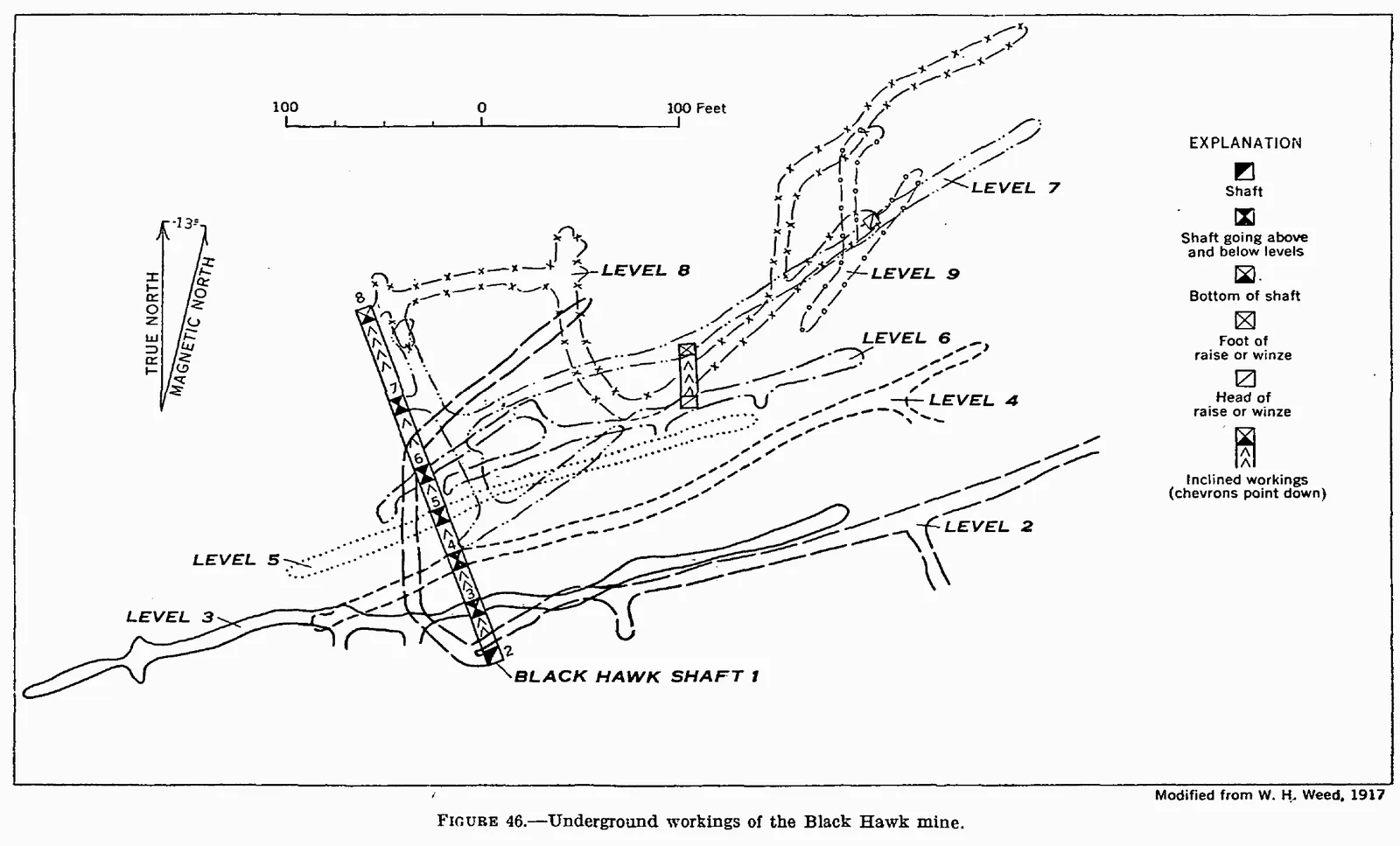
Underground workings of the Black Hawk mine: levels 2 to 9 and Black Hawk shaft 1, modified from W. H. Weed’s plan of 1917. Figure 46 of USGS Bulletin 1009-K (1956). U.S. Geological Survey; public domain. Cropped and resized.
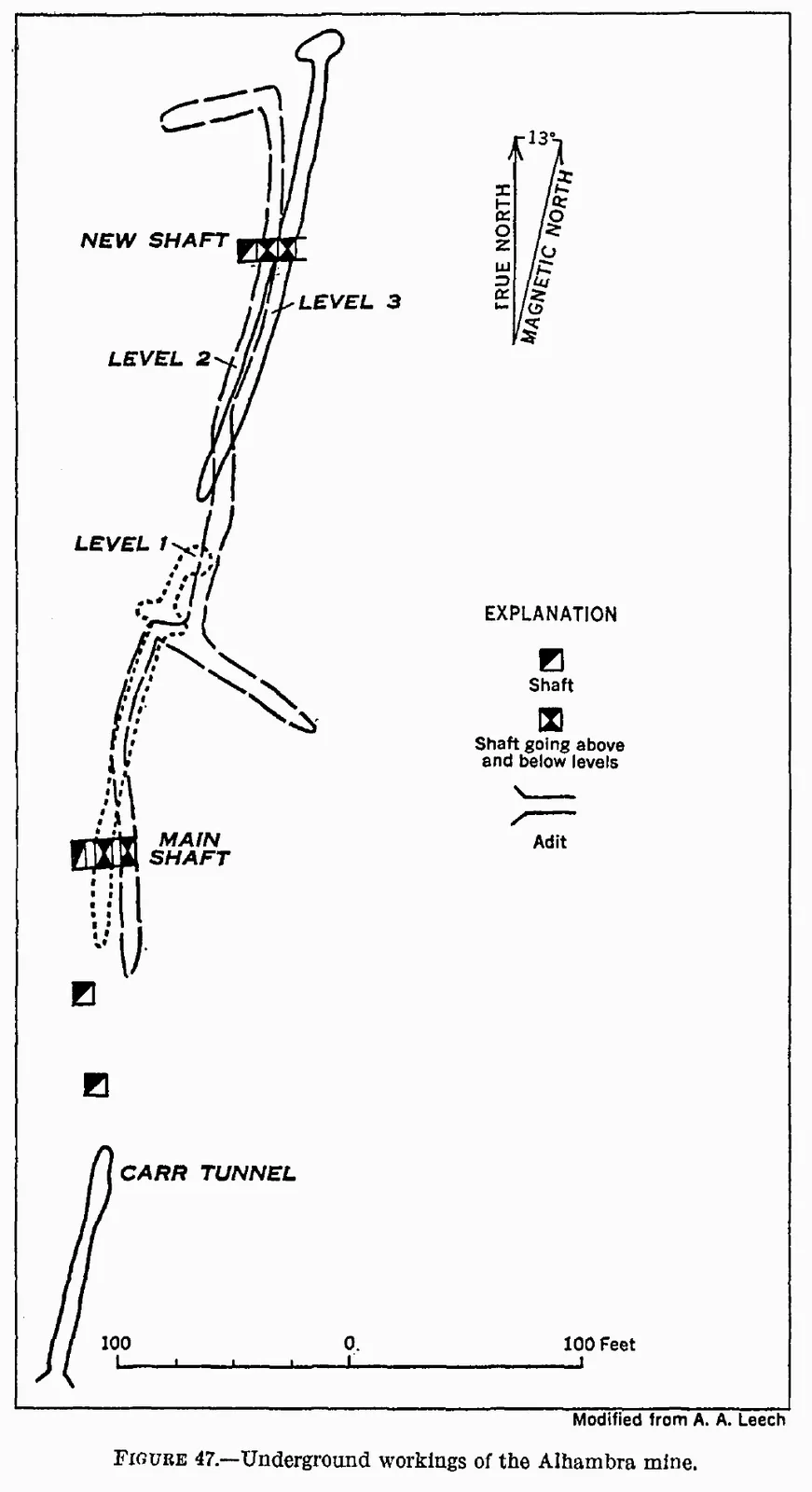
Underground workings of the Alhambra mine: the main shaft, the new shaft, three levels and the Carr tunnel, modified from a plan by A. A. Leach. Figure 47 of USGS Bulletin 1009-K (1956). U.S. Geological Survey; public domain. Cropped and resized.
Newspapers added their own numbers. The Mint report for 1885 had good ore coming from 700 feet, and a Santa Fe paper in 1906 gave the main shaft as 700 feet deep. A 1911 item said 600 feet, and a 1913 item said 500 feet and full of water. Some of the difference is between depth measured down a sloping shaft and depth straight down. Some is plain disagreement. (Sources: Report of the Director of the Mint upon…, p. 168; Santa Fe New Mexican, 1906-04-13, p. 3; Santa Fe New Mexican, 1911-07-07, p. 3; Santa Fe New Mexican, 1913-04-17, p. 2.)
The Alhambra was shallower. Jones gave it about 400 feet with a like amount of drifts, and Graton a 400-foot incline. The 1956 report says its ‘New shaft’ is reported to be 420 feet deep, with deeper levels that do not appear on the surviving maps. The Rose shaft is reported at 200 feet. The Hobson is given as about 300 feet by Jones, about 200 by Graton, and as a 300-foot tunnel with an inclined shaft by the 1956 report. (Sources: New Mexico Mines and Minerals, p. 55; The Ore Deposits of New Mexico, p. 325; Uranium-bearing nickel-cobalt-native…, p. 306, p. 307, p. 309.)
What the district produced
How much silver came out? No one kept a full account, and every figure is an estimate.
For the whole district: Graton in 1910 put the camp’s total at ‘perhaps $1,000,000’. Gillerman and Whitebread, drawing on Graton and on a 1916 report by A. A. Leach, give between $1,000,000 and $1,500,000 before 1893, and say more than a million dollars’ worth is said to have been shipped between 1881 and 1893. Granger and Bauer, also federal geologists, say $1.5 million in seven years. The state’s 2017 table credits the district with over $1 million between 1881 and 1960. (Sources: The Ore Deposits of New Mexico, p. 324; Uranium-bearing nickel-cobalt-native…, p. 286, p. 283; Radioactive deposits in New Mexico, p. 349; Mining districts and prospect areas in…, Appendix 1.)
For the single mines: Jones says the Solid Silver company’s own records showed the Black Hawk had produced nearly $600,000, and the 1906 territorial handbook and Anderson repeat $600,000. The federal reports give $600,000 to $650,000 for the Black Hawk, about $400,000 for the Alhambra, about $140,000 for the Rose, where Graton had been told $100,000, and about $40,000 for the Silver King. Granger and Bauer say about half the district’s silver came from the Black Hawk and the rest from the Alhambra, Rose and Hobson, all within a mile of it. A Denver newspaper survey reprinted in 1901 put the total of what it called the Black Hawk, ‘now known as the Alhambra’, at over $500,000; it treats two separate mines as one. (Sources: New Mexico Mines and Minerals, p. 55; The Land of Sunshine, p. 237; History of New Mexico, p. 947; Uranium-bearing nickel-cobalt-native…, pp. 286-287, p. 287; The Ore Deposits of New Mexico, p. 325; Radioactive deposits in New Mexico, p. 349; Santa Fe New Mexican, 1901-09-27, p. 2.)
The carload stories grew in the telling. The Mint report for 1883 gives $7,000 to $8,000 a carload. Jones, in 1904, repeats that one carload was said to have brought almost $28,000. The 1901 survey has a single carload selling for $30,000 and ore ‘lacking but 5 per cent of being solid silver’. And all of these totals leave out whatever was stolen, which Graton was told might be half. (Sources: Report of the Director of the Mint upon…, p. 573; New Mexico Mines and Minerals, p. 55; Santa Fe New Mexican, 1901-09-27, p. 2; The Ore Deposits of New Mexico, p. 325.)
The checked facts for this part, with their locators, are on the Atlas page Black Hawk: the ore, the mines and what they produced.
The quiet years, 1894 to 1920
Sold at the courthouse
The boom’s last big property went under the hammer within months. The Southwest Sentinel reported that the Alhambra mine of Black Hawk was sold under a court execution by the sheriff on February 26, 1894, for $500, subject to liens and claims of about $50,000; the scan prints the figure as ‘850,000’. A former United States attorney for New Mexico, E. A. Fiske of Santa Fe, spent several days in Silver City on business connected with the sale. Four years earlier the same mine had brought $100,000. (Sources: Southwest-sentinel, 1894-02-27, p. 3.)
The quarrel moved to Chicago. The Eagle reprinted a Chicago Tribune report that on February 23, 1895, James R. Young, a stockholder in the Alhambra Mining Company, asked the federal court there to appoint a receiver and order an accounting. In his filing he claimed the mine had been paying and was still paying. That is a litigant’s claim, and the outcome was not found. (Sources: The Eagle, 1895-03-13, p. 6.)
The people who stayed
A small community held on, and the newspapers let us name some of it. In 1894 the Black Hawk precinct sent three delegates to the county Democratic convention, at one delegate for every ten Democratic votes, and Republicans there chose delegates too. By May 1896 the precinct was entitled to only one Democratic delegate. For the November 1896 election its polling place was the assay office. (Sources: Southwest-sentinel, 1894-04-17, p. 3; Southwest-sentinel, 1894-09-11, p. 3; The Eagle, 1896-05-20, p. 8; The Eagle, 1896-10-21, p. 10.)
One family name runs through these years. H. FitzSimmons appears as ‘of Alhambra’ in The Eagle in 1895, as precinct committeeman in 1896, and in the Official Register of the United States as postmaster at Alhambra in 1895, 1897 and 1899, at about $20 a year. In September 1895 the paper noted that a Fitzsimmons daughter would stay in Silver City to attend the public school. In 1902 he was sending weather reports from Alhambra to Santa Fe: no snow that February, he wrote, but ten hours of steady rain on the 25th. (Sources: The Eagle, 1895-03-27, p. 4; The Eagle, 1896-10-07, p. 6; Official Register of the United States,…, Post-Offices and Postmasters; Official Register of the United States,…, Post-Offices and Postmasters; Official Register of the United States,…, Post-Offices and Postmasters; The Eagle, 1895-09-11, p. 4; Santa Fe New Mexican, 1902-02-07, p. 3; Santa Fe New Mexican, 1902-03-10, p. 3.)
Ranching carried the country when mining did not. Will Toney of Black Hawk was married in Silver City in November 1894, and T. Toney brought cattle in from Alhambra for shipment the next spring. Creighton M. Foraker, who had farmed and raised stock on a ranch near Alhambra for about ten years, became United States Marshal for New Mexico in 1897. The Foraker brothers later sold their ranch and brand to Martin Mullen and the Whitmire brothers. In 1905 two Stockman brothers took up ranches three miles from Black Hawk and stocked them with Angora goats. That year’s tax roll put the precinct’s taxable property at $33,040, against $602,060 for Silver City. (Sources: The Eagle, 1894-11-28, p. 9; The Eagle, 1895-04-17, p. 4; Santa Fe Daily New Mexican, 1897-08-03, p. 2; The Eagle, 1896-08-19, p. 4; Albuquerque Evening Citizen, 1905-08-05, p. 7; Las Vegas Daily Optic, 1905-05-01, p. 2; Santa Fe New Mexican, 1905-08-17, p. 5.)
One death notice opens a wider history. In July 1896 the Las Vegas Daily Optic reported the death at Alhambra of a man known as ‘Gov. Jackson’, so called because before the Civil War he had been enslaved by Governor Jackson of Missouri. He had acquired some property in the mining camp. The paper does not give his own name. Jones’s account of ‘Cherokee Jim’ Bowman is the other notice of a Black man found in the district’s record for these pages. (Sources: Las Vegas Daily Optic, 1896-07-23, p. 3; New Mexico Mines and Minerals, p. 54.)
Picking over the dumps
Mining shrank to salvage and hope. In February 1897 the New Mexican reported a few men sorting and washing the old waste dumps at the Alhambra and Black Hawk mines, recovering enough ore to make it pay. In 1898 a Black Hawk mining company of Wisconsin named Alhambra as its place of business in New Mexico and H. Fitzsimmons as its agent. That April the old Alhambra shaft was pumped out, and the mine was to be overhauled and retimbered, ready for work ‘should silver advance’. A mail contract from Silver City to Alhambra was let that year at $334 a year. (Sources: Santa Fe Daily New Mexican, 1897-02-02, p. 1; The Eagle, 1898-03-30, p. 6; Santa Fe New Mexican, 1898-04-07, p. 4; Santa Fe New Mexican, 1898-04-20, p. 1; Santa Fe New Mexican, 1898-01-12, p. 1.)
Official reports stayed hopeful. Governor Otero’s report for 1899 said the Alhambra mine was being worked and very rich ore taken out, and named Black Hawk among camps ‘attracting their share of attention’. A Denver survey printed in 1901 called the property idle. In July 1901 a part-owner named Burdick was reported to have found a fine body of ore next to the Black Hawk mine, in a district the paper called ‘one time famous’. (Sources: Report of the Governor of New Mexico to…, p. 318, p. 154; Santa Fe New Mexican, 1901-09-27, p. 2; Santa Fe New Mexican, 1901-07-03, p. 1.)
The post office did not outlast the lull. The New Mexican announced on March 28, 1902, that the office at Alhambra would be discontinued on March 31. Small work went on: a contract was let on the Silver Reef claim that spring, and by September it was down eighty feet. In June 1902 a man sinking a shaft in the district was overcome by bad air, fell, and broke a fellow miner’s leg in landing on him. (Sources: Santa Fe New Mexican, 1902-03-28, p. 1; Santa Fe New Mexican, 1902-05-21, p. 1; White Oaks Eagle, 1902-09-04, p. 6; Santa Fe New Mexican, 1902-06-19, p. 1.)
When the federal geologist L. C. Graton came in 1905 he found ‘the deserted little camp of Black Hawk, or Alhambra’. Jones had noted the year before that the Solid Silver Mining Company still held its eight patented claims. (Sources: The Ore Deposits of New Mexico, p. 324; New Mexico Mines and Minerals, p. 55.)
Trying again
From 1906 the old mine drew a new promoter every few years. In April 1906 J. W. Fleming of Silver City was appointed New Mexico agent of the Black Hawk Solid Silver Mining Company of Minneapolis, which the New Mexican took as a sign of work to come. In January 1907 Capt. T. S. Parker took an option on the mine; the Enterprise remarked that except for brief intervals it had stayed closed since the fall in the price of silver. That May a Silver City attorney said work had resumed in the old camp and prospecting was lively. A review of the year found signs of activity at Bullard’s Peak but little production. (Sources: Santa Fe New Mexican, 1906-04-13, p. 3; Albuquerque Evening Citizen, 1907-01-23, p. 5; Santa Fe New Mexican, 1907-05-14, p. 1; Santa Fe New Mexican, 1908-01-27, p. 7.)
The best news came from a shallow hole. In November 1910 the New Mexican reported that Colonel Fleming had brought in the richest ore found in Grant County for many years, from the Chicago mine, one of seven claims he owned with Barney Carr. The strike was made in a shaft only eight feet deep. The ore was said to be about 75 per cent native silver, and fourteen sacks were ready to ship to the smelter at El Paso. In January 1911 he showed samples of rich horn silver from deeper on the same strike. (Sources: Santa Fe New Mexican, 1910-11-25, p. 7; Santa Fe New Mexican, 1911-01-20, p. 3.)
Then came leases and machinery. In July 1911 Theodore Carter and associates were reported to have leased the old Black Hawk mine, its shaft in bad condition. In March 1912 a J. E. Pierson was operating a lease at Black Hawk. In April 1913 the mine’s manager, J. R. Ghiselin, contracted for a fifty-horsepower oil engine, an air compressor and three rock drills, and the flooded shaft was being enlarged and pumped out. (Sources: Santa Fe New Mexican, 1911-07-07, p. 3; Albuquerque Morning Journal, 1912-03-10, p. 8; Santa Fe New Mexican, 1913-04-17, p. 2.)
The reopening of 1917
The fullest attempt came with the First World War. Gillerman and Whitebread say that in 1917 a new owner pumped out the Black Hawk mine and reopened it to its lowest levels, where undeveloped high-grade ore was reported. The consulting geologist W. H. Weed and A. A. Leach, then geologist for Phelps Dodge at Tyrone, examined it and recommended more work. Weed’s report was written for the Black Hawk Mining and Milling Company of Silver City. (Sources: Uranium-bearing nickel-cobalt-native…, p. 286; The uranium-bearing nickel-cobalt-native…, Unpublished reports.)
The camp came back to life for a season. A Silver City dispatch of March 1917 described Black Hawk as a mining camp eighteen miles west of town where miners were living in cabins. It reported a fatal shooting between two miners there, which a coroner’s inquest found to be self-defense. That April an Alhambra Silver Mining Company was reported being organized to take over the Alhambra. (Sources: Albuquerque Morning Journal, 1917-03-18, p. 3; New Mexico State Record, 1917-04-27, p. 4.)
It did not last. All work at the Black Hawk stopped shortly after the examinations, the federal report says, and a brief interest in smaller properties in the eastern part of the district faded too. Granger and Bauer say the mine was reopened for exploration only and that reports do not show any ore was mined. (Sources: Uranium-bearing nickel-cobalt-native…, p. 286; Radioactive deposits in New Mexico, p. 350.)
The record after 1917 is thin and does not agree with itself. In August 1919 an Albuquerque paper, quoting the Silver City Independent, listed the Cobalt Corporation of America among companies active in the Black Hawk camp. The federal mineral database lists the Black Hawk Consolidated Mines Co. as owner from 1919, and production in 1919 and 1920 of ore rich in lead and poor in silver, which is unlike anything else recorded from this district and may belong to another mine. It also lists an operator at the Rose in 1920. Against this, Gillerman and Whitebread wrote in the 1950s that the district had been idle since 1917. (Sources: Albuquerque Morning Journal, 1919-08-07, p. 5; Mineral Resources Data System, Ownership information, Production statistics; Mineral Resources Data System, Ownership information; Uranium-bearing nickel-cobalt-native…, p. 286.)
One find of 1920 mattered later. Gillerman and Whitebread say pitchblende, a uranium ore mineral, was recognized that year on the dumps of some of the old mines, and a federal bulletin says the discovery was recorded in the Engineering and Mining Journal by F. I. Leach. For the next quarter century nobody had much use for it. (Sources: Uranium-bearing nickel-cobalt-native…, pp. 283-284; Radioactive deposits in New Mexico, p. 316.)
The checked facts for this part, with their locators, are on the Atlas page Black Hawk: the quiet years, 1894 to 1920.
The search for uranium, nickel and cobalt, 1944 to today
A new reason to look
The atomic age sent people back to the old dumps. In 1944 S. B. Keith made a reconnaissance of the White Signal, Black Hawk and San Lorenzo districts for the Union Mines Development Corporation, part of a wartime search for uranium. In 1945 two men of the U.S. Bureau of Mines wrote a ‘War Minerals’ memorandum on the Bullard Peak district. Neither report was published. (Sources: Uranium deposits in Grant County, New Mexico, Unpublished reports; The uranium-bearing nickel-cobalt-native…, Unpublished reports.)
An owner pushed the matter. In 1948 Albert A. Leach, owner of the Alhambra mine, drew the Bureau of Mines to the district by sending old mine reports and specimens containing silver, nickel, cobalt and uranium. The Bureau made a brief examination on July 24, 1948, and took two dump samples. The one from the Alhambra dump assayed 34.70 ounces of silver per ton with a little nickel and cobalt, and the one from the Rose dump 10.55 ounces. Neither was tested for uranium. (Sources: Radioactive deposits in New Mexico, p. 350.)
Interest revived in earnest in 1949, Gillerman and Whitebread say, because the country needed more nickel, cobalt and uranium. That year a Bureau of Mines engineer wrote a proposal for a uranium, cobalt and nickel development project in the district, and in July Bureau engineers went over the Alhambra dump with a Geiger counter and found one small pile of ore slightly radioactive. (Sources: Uranium-bearing nickel-cobalt-native…, p. 286; The uranium-bearing nickel-cobalt-native…, Unpublished reports; Uranium deposits in Grant County, New Mexico, Radioactivity.)
The geologists’ visits
The first Geological Survey visit found little. On March 19, 1950, H. C. Granger and H. L. Bauer, Jr. ran radioactivity traverses over the Black Hawk mine dump and others on the same vein, and tested rocks along Black Hawk Canyon. They found no radioactivity above twice the normal background on those dumps. But a specimen of Black Hawk ore owned by Ira Wright, about 60 to 80 percent native silver, proved strongly radioactive when they tested it. (Sources: Radioactive deposits in New Mexico, p. 349; Uranium deposits in Grant County, New Mexico, Radioactivity.)
A closer look found more. In the spring of 1951 A. J. Gude 3d and Elliot Gillerman checked dumps, pits and shafts and found small amounts of pitchblende on the dumps of the Black Hawk and Alhambra mines. The full study identified pitchblende at both deposits and unidentified radioactive minerals at five other places. One specimen from the Black Hawk dump held 0.24 percent uranium oxide. At the Good Hope, radioactive material could not be identified as a mineral, but analysis showed uranium, nickel, silver and cobalt. The authors compared the ores to those of Great Bear Lake in Canada and Joachimsthal in Czechoslovakia, both known uranium producers. (Sources: Uranium-bearing nickel-cobalt-native…, p. 284, p. 283, p. 305, pp. 309-310.)
What they could see was limited, because the mines were closed. The Black Hawk No. 1 shaft, in the bottom of a dry gulch, was filled with sand and debris, with only a few pipes sticking out to show where it was. The mine’s four vertical shafts and one inclined shaft were all caved. The Alhambra shaft was caved around its mouth, with water standing about 40 feet down. The Good Hope shaft was filled. The Black Hawk could be reached by road, but the Alhambra was more than a quarter mile from the road over rough ground. (Sources: Uranium-bearing nickel-cobalt-native…, p. 302, p. 306, p. 309; Uranium deposits in Grant County, New Mexico, Black Hawk mine; The uranium-bearing nickel-cobalt-native…, Conclusions and suggestions.)
Drilling in 1952
One company tried to reach the vein below the old workings. In the spring of 1952 the federal government granted an exploration loan to the Black Hawk Consolidated Mines Co. In May the company began diamond drilling, putting down three 1,000-foot holes. Holes 1 and 2 met nothing that could be recognized as the Black Hawk vein. Hole 3 passed through a vein with a few specks of galena, pyrite and native silver between 641 and 651 feet, and assays showed only a trace of silver. (Sources: Uranium-bearing nickel-cobalt-native…, p. 286, p. 305.)
The geologists drew a careful lesson. Up to the early 1950s no uranium ore had been shipped from the district, though the compilers of a federal bulletin thought it worth further exploration. Gillerman and Whitebread advised that any new work should begin by pumping out and repairing the larger mines and then mapping and sampling the veins, because drilling such patchy ore would be inconclusive. (Sources: Radioactive deposits in New Mexico, p. 317; Uranium-bearing nickel-cobalt-native…, p. 310.)
Who owned the ground
The federal reports record the owners of the 1950s. The Black Hawk group of patented claims belonged to the Black Hawk Consolidated Mines Co. of Milwaukee, Wisconsin, with Ira Wright of Silver City as general manager; in 1952 the property was 14 claims, 8 of them patented. The 1953 report lists the eight as the Black Hawk, Silver Glance, Cornucopia, Surprise, Kent County, Little Rhody, Chicago and Extension, the same eight names the Mint had listed for the Solid Silver Mining Company in 1882. The 1956 report leaves out the Cornucopia. (Sources: Uranium-bearing nickel-cobalt-native…, pp. 285-286; Uranium deposits in Grant County, New Mexico, Black Hawk mine; The uranium-bearing nickel-cobalt-native…, Ownership; Report of the Director of the Mint upon…, p. 358.)
The Alhambra group belonged to Albert A. and Frances I. Leach of Lordsburg. The 1953 report lists its patented claims as the Alhambra, Stonewall, Good Hope, Pumpkin and Butternut. The Rose claim was owned by two women in California. The federal mineral database gives the Black Hawk group as eight patented claims covering about 75 acres and the Alhambra group as five covering about 85 acres. (Sources: Uranium-bearing nickel-cobalt-native…, p. 286; The uranium-bearing nickel-cobalt-native…, Ownership; Mineral Resources Data System, General comments; Mineral Resources Data System, General comments.)
Since the 1950s
After the federal studies the checked record thins out quickly. The federal mineral database says workings reported at the Alhambra in 1964 were an inclined shaft with seven levels and at least 2,000 feet of drifts, with much of the upper mine caved. It lists Hondo Mining of Silver City as operator of the Alhambra from 1980 and Sharon Steel Corp. of Hanover as owner from 1982. It says reserves are unknown, though more than 20,000 feet of possible veins are present, and it repeats an unpublished inference of 500,000 pounds of cobalt, which is a guess from geology and not a measured reserve. (Sources: Mineral Resources Data System, Comments on the workings information, Ownership information; Mineral Resources Data System, Comments on the reserve resource information.)
That database needs care. Its Alhambra record has text from an unrelated district mixed into it, so its statements that production lasted to 1960 and peaked during the Depression cannot be relied on for this mine. (Sources: Mineral Resources Data System, Comments on development.)
More recent ownership, and the modern study of these veins by state geologists, are described in company filings and state publications that could not be opened when these pages were written. They are listed under what is still uncertain. The patented claims are private property, and the old shafts are caved, flooded or filled. Nothing in this history is a guide to visiting them.
The checked facts for this part, with their locators, are on the Atlas page Black Hawk: the search for uranium, nickel and cobalt, 1944 to today.
What the record has not settled
Some basic questions remain open in the sources checked so far. Only Jones, writing in 1904, names a discoverer: a Black prospector named Bowman, known as ‘Cherokee Jim’, followed by John Black and a partner named Sloan. Nothing read from the 1880s confirms or contradicts him. The federal geologists give two different reasons for the closing of the mines, and three different years for the closing of the Black Hawk mine itself. Estimates of the silver produced run from ‘perhaps $1,000,000’ to $1.5 million, and one geologist was told that half of it may have been stolen. John Bullard’s death in 1871 has four dates and two places.
Other gaps are gaps in what could be opened. The New Mexico Bureau of Geology’s publications, including Gillerman’s 1964 bulletin beyond the two pages already checked and the recent studies of these veins, could not be reached for this round. Neither could the company filings that describe ownership since 2017, the Post Office Department’s own records, or the land patent files. The Silver City Enterprise before 1888 was read only where other papers reprinted it.
The Atlas Black Hawk pages list every checked fact behind this chapter, a timeline of dated events, and links to the maps and reports themselves. The district’s patented claims are private property and its old shafts are caved, flooded or filled; nothing here is a guide to visiting them. For the wider county, see Grant County From the Record; for the present-day prospecting questions, see Black Hawk and Alhambra: The Burro Mountains’ Stranger Silver Story.
Loading comments…