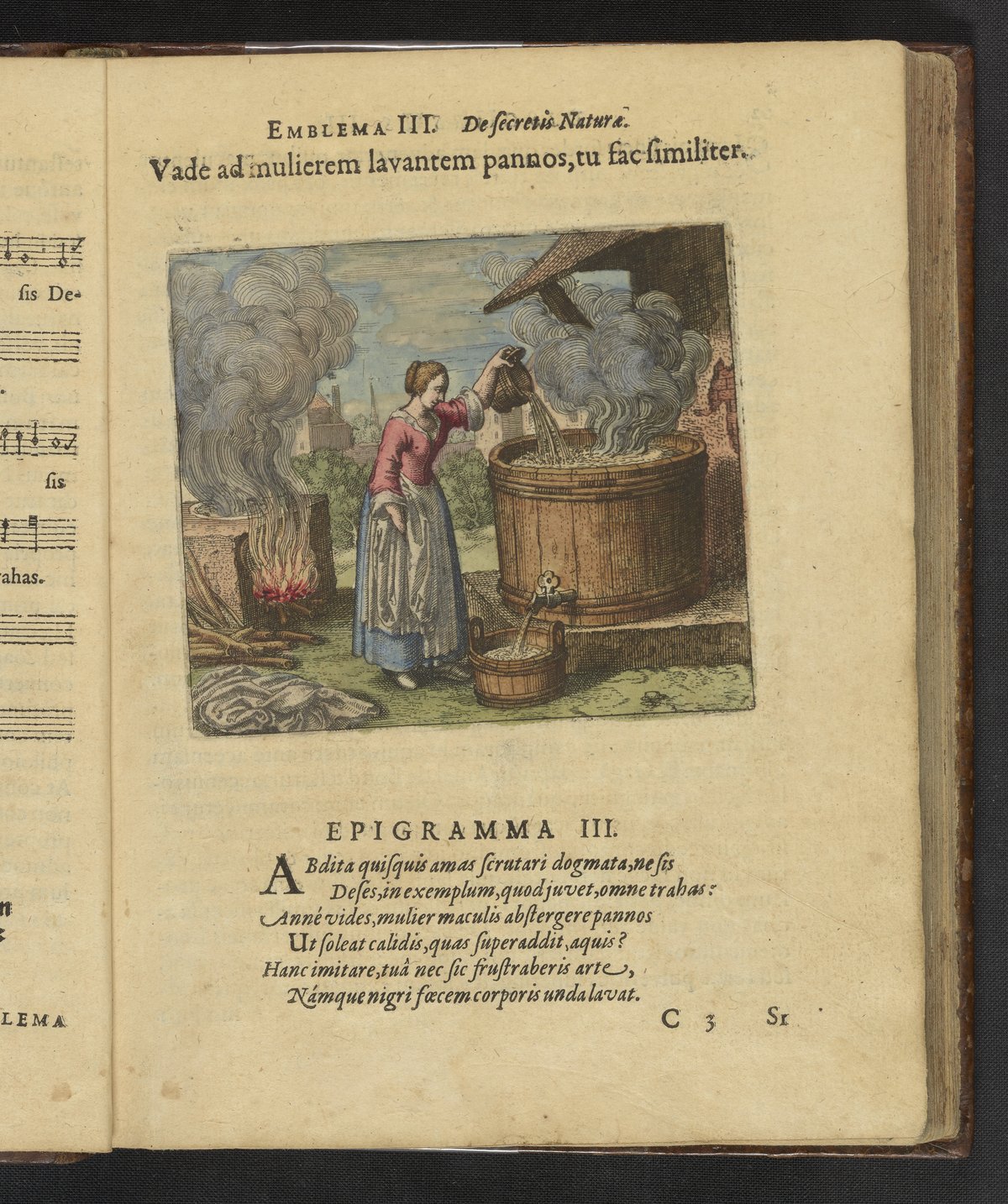
An alchemical emblem sends its reader to the laundry. In Emblem III of Michael Maier’s Atalanta fugiens, a woman works beside a furnace and washing equipment. The lesson concerns purification. The Science History Institute’s interpretive exhibition connects this particular scene to Maier’s account of calcination: material altered and purified through heat.
If you met the picture without its text, you might call it an image of domestic life, emotional cleansing, women’s work, or transformation. Some of those responses might lead to interesting questions. Maier’s accompanying explanation gives the image a more particular job. The laundry supplies a recognizable action through which a less familiar operation can be considered.
That is the pleasure of reading a symbol closely. The picture begins to do work, and the work becomes more precise than the first association that came to mind.
The words beside the image matter
A symbol dictionary encourages a quick exchange: look up the object, collect its meaning, move on. An emblem asks for a slower encounter. Attend to the depicted action, the motto or caption, the accompanying explanation, and the work in which they appear. Those elements can constrain one another.
With Maier’s washerwoman, the action matters as much as the object. A basin alone does not say what someone is doing. Washing, heating, pouring, and separating suggest a sequence. The text places that sequence inside the author’s alchemical purposes. Turning the basin immediately into “the unconscious” would skip the evidence that makes this image distinctive.
The exhibition also notes that later hand-coloring affects details in the copy it discusses. Even the apparently immediate act of looking has a history: which copy are we seeing, and what was added to it? That does not make the image unreadable. It gives us another useful question to ask of the object. Exhibition discussion of Emblem III.
A modern reader might use the washing scene as a prompt to think about revising a mistaken belief. That would be a new application. It can be valuable without becoming evidence that Maier secretly wrote a contemporary self-help exercise. Keeping the two readings distinct lets each be judged fairly.
Dee builds a diagram rather than a dictionary
John Dee’s Monas hieroglyphica, published in Antwerp in 1564, develops a compact sign through a sequence of theorems. In the opening theorems he joins point, line, circle, lunar semicircle, cross, and the sign of Aries. He connects the parts with celestial, numerical, elemental, and alchemical considerations. The text in J. W. Hamilton-Jones’s translation lets a reader follow the construction instead of guessing from the completed glyph; the Library of Congress record identifies the historical edition.
Dee’s cross receives more than one numerical reading. Theorem VI considers it through intersecting lines and through the four divisions those lines make. Theorem VII links four directions to the elements. Theorem X assigns a role to Aries in relation to fire. Meaning accumulates through an argument. A single caption under the completed sign cannot reproduce that progression.
The interpretive problem is therefore sharper than “What does a cross mean?” It is “What relationship does Dee establish at this point in his argument?” We can reconstruct an author’s reasoning without accepting every proposition in his cosmology. Understanding an explanation is the first step in evaluating it.
Try a small reading exercise. Open the translation at Theorem VI and sketch the two intersecting lines on plain paper. Count the lines, then the divisions, noticing how the count changes with the feature you select. Read the author’s numerical explanation. You have now identified one of the operations the text performs: it selects aspects of the same shape to generate different relationships. This is a textual exercise, not a ritual or a demonstration that the number possesses a hidden physical force.
The discrepancy between the simplicity of the figure and the ambition of its explanation is part of its fascination. A reader can see a shape at once and need considerable time to understand the system built around it.
Resemblance is a starting point
Imagine, as a hypothetical comparison, three pages that all show a sun above a cross. One belongs to an early printed treatise, another to a later ceremonial curriculum, and the third to a recent personal journal. The shapes may resemble one another closely. Their meanings still need three separate accounts.
The early treatise may explain a cosmological relationship. The curriculum may assign the figure a place within an ordered system. The journal writer may use it to remember hope during grief. To establish a link among them, ask whether the later writer names an earlier source, reproduces its explanation, or changes its use. The resemblance tells us where to look; the surrounding evidence tells us what traveled.
This protects a symbol from becoming a blank surface onto which every reader projects the same universal answer. It also protects the journal writer’s new meaning. Personal interpretation does not have to impersonate antiquity to matter.
Borrowed religious symbols require particular care with their source traditions. Renaissance Christian engagement with Jewish Kabbalah, discussed in the Cambridge historical chapter, is an encounter and interpretation. A Christian or Hermetic use of Jewish-derived material should be identified by its author and setting; it cannot stand in for what every Jewish reader means by it. Spelling a term differently is less informative than explaining who uses it and for what purpose.
Four sentences can keep a reading honest
A short note can preserve the levels of an interpretation without draining its life. For a clearly hypothetical modern reflection on Maier’s image, it might read:
- Observation: The image places a washerwoman beside washing equipment and a furnace.
- Historical interpretation: The exhibition connects the scene to Maier’s explanation of purification through heat.
- Personal association: The scene reminds me of separating useful criticism from a painful delivery.
- Limit: That association is my present application, not an account of Maier’s intention or proof of therapeutic benefit.
The sentences are useful because they can change independently. A better image might correct the observation. A newly examined passage might refine the historical interpretation. A personal association might stop being fruitful. None of those revisions requires pretending that all meaning was arbitrary in the first place.
SalarsNet’s Rose Cross and Rose Heart comparison offers a related contemporary case: recognizable imagery accompanies an explicitly changed practice. Read it as an account of that adaptation, alongside the historical sources it names.
By the time the notebook closes, the image should have gained detail rather than merely acquired a grand label. We have seen someone work, followed an author’s explanation, and noticed what a later reader contributes. The symbol remains open to further thought, but it now belongs somewhere.
Loading comments…