A pair of wooden doors can carry a field of stars. An almond-shaped frame can gather a mother and child into the center of a painted church. A philosophical dialogue can assign solid shapes to the elements. All three give geometry a consequential role, but the consequences are different.
To understand what these forms meant, stay with the particular works. A text supplies an argument. An object's material and use place ornament in human activity. A religious picture asks its shapes to work with figures and stories. Three examples show how much becomes visible once a pattern has an address.
Plato gives the solids a physical job
In the Timaeus, Plato's speaker builds a cosmological account from triangles and solids. He assigns the cube to earth, the tetrahedron to fire, the octahedron to air and the icosahedron to water. These are proposed as minute constituents, too small to see individually. The explanation links the shapes to qualities such as stability and mobility: the cube suits the relatively immovable earth, while the sharp, small form assigned to fire suits its penetrating action. Plato, Timaeus, 53c–55c, translated by Benjamin Jowett.
The shapes give the account something to reason with. A cube has square faces; a tetrahedron has triangular ones. Those differences can be examined as geometry. Assigning either body to a substance is an additional move. A geometrical construction does not establish that earth consists of microscopic cubes, or that fire consists of tetrahedra.
Imagine making paper models of the two solids. Placing them on a desk lets you compare faces and corners. That activity can illuminate an ancient author's choice without reproducing the proposed particles, measuring a material or confirming the cosmology. The exercise brings the argument into reach; it does not change the kind of evidence the argument would require.
Plato's account deserves to be read in its own terms, including its language of probability. Treating it merely as an imperfect chemistry lesson misses the ambition to give a connected explanation. Treating it as a secretly verified modern theory misses the distance between a constructed solid and a demonstrated physical constituent. Its interest lies partly in watching a thinker make that connection explicit.
For a modern example of geometry's relationship to a material, Same Carbon, Different Matter distinguishes atomic arrangement from the forces needed to explain behavior. It answers a different question from the historical one here.
Stars on the doors of a pulpit
The Metropolitan Museum holds a pair of minbar doors dated about 1325–30. A minbar is a pulpit reached by stairs, used by an imam for the Friday sermon; doors such as these stand at its base. The museum describes their geometric inlay as characteristic of the Mamluk period and says they are thought to come from the mosque of Saif al-Din Qawsun in Cairo. Inlay sets pieces of contrasting material into a surface to make the design. That origin is an attribution, rather than a certainty supplied by the pattern itself. The Met, Pair of Minbar Doors.
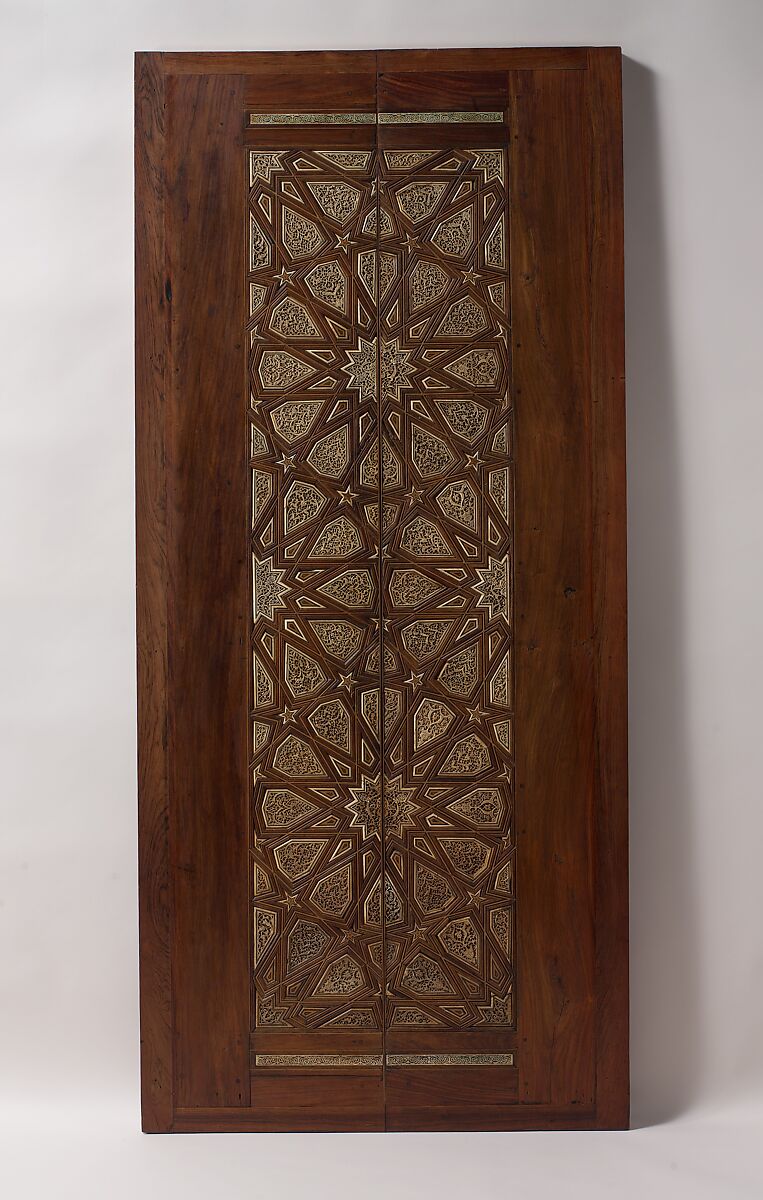
Pair of Minbar Doors, about 1325–30. Wood with carved and inlaid ivory and other woods. Metropolitan Museum of Art; public-domain image.
In the museum's photograph, pale lines divide the darker wood into a closely fitted network. Stars draw the eye to larger centers; smaller polygons carry the pattern between them. The vertical join remains visible through the design. Reading across the join reveals the larger field; each leaf remains bounded by its frame.
That join is worth attending to. The ornament has to occupy an object with an edge, a frame and an opening. It is an arrangement in material, made for a particular role. Thinking about those requirements gives the design another dimension of interest beyond recognizing a star.
The recorded pulpit function establishes a religious setting. It does not establish a separate doctrinal meaning for every polygon. To make that more specific claim, we would need relevant testimony, an inscription or a documented explanation. We can still appreciate the workmanship and ask how repetition shapes the experience of approaching an elaborately decorated object.
A nearby comparison prevents “Islamic ornament” from becoming shorthand for geometry alone. A tile from a mihrab in the same museum is dated 722 AH, or 1322–23 CE. Its inscription relates to the niche's prayer function, while modeled vines and tendrils occupy the surface. Text and plant forms can participate in a religious object's decoration alongside its shape. The Met, Tile from a Mihrab.
An almond around the Virgin and Child
A Catalan fresco offers a different relationship between geometry and subject. The Virgin and Child in Majesty and the Adoration of the Magi, dated about 1100 and attributed to the Master of Pedret, places the enthroned figures at its center. The museum records its medium as fresco transferred to canvas. It originally came from the church of the Virgin near Tredòs in the Pyrenees. The Met, object 50.180a–l.
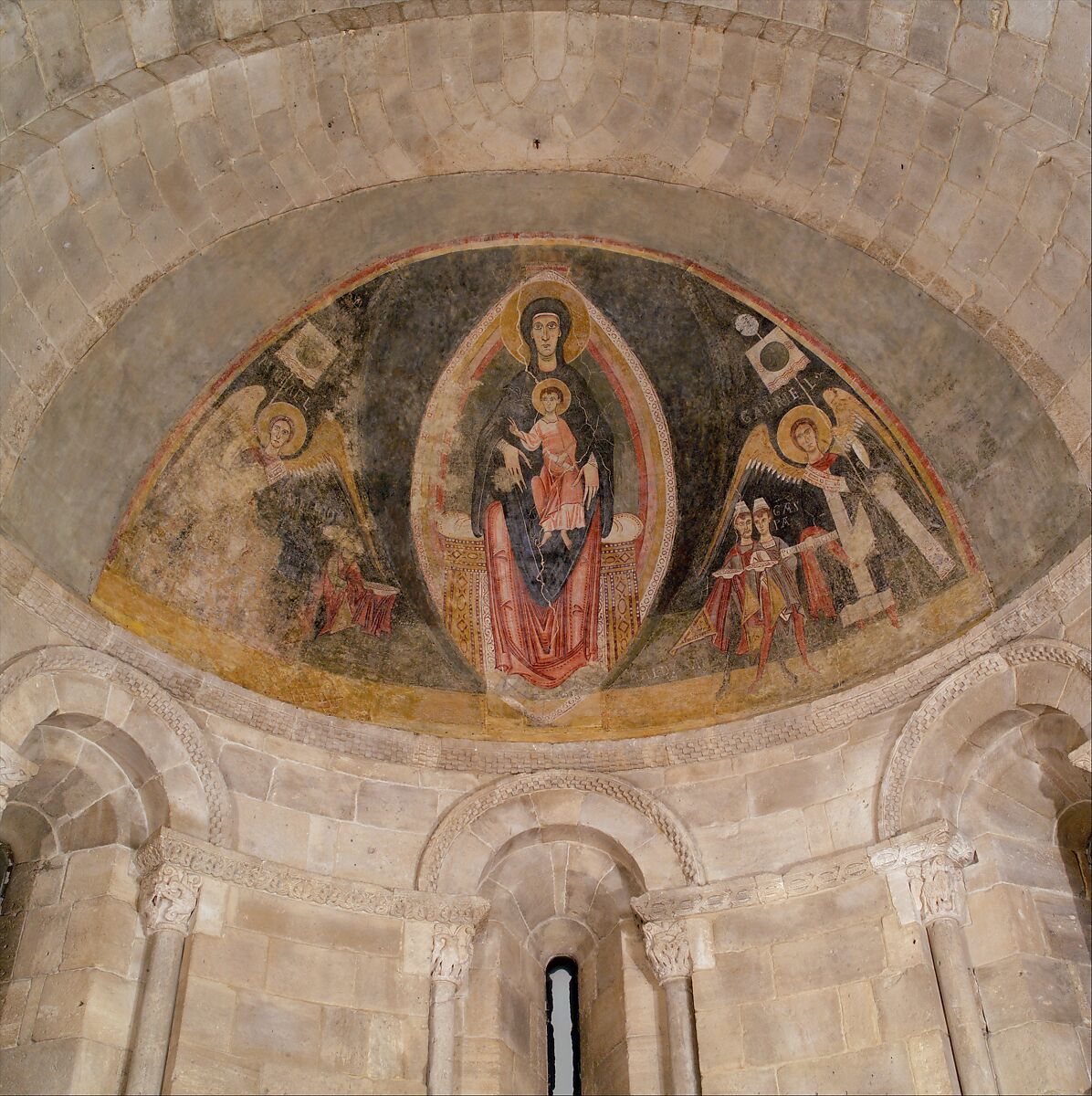
The Virgin and Child in Majesty and the Adoration of the Magi, about 1100, attributed to the Master of Pedret. Metropolitan Museum of Art, The Cloisters Collection; public-domain image. The museum display combines the fresco with an apse from a different site.
Look at the photograph's center. The tall almond-shaped boundary encloses both figures. Their circular halos remain separate from that larger outline. The smaller figures around them turn a simple frame into part of a composition: attention is drawn inward, while the gathering around it establishes relationships between the participants.
Calling the boundary an almond describes its appearance. Claiming a precise two-circle construction would require further examination. The figures, their relative scale and the stated subject already give us much more to understand than an isolated outline could supply. Here the pattern's religious setting is visible through what it frames.
One further detail changes the reading of the photograph. The fresco is now mounted in the apse from Fuentidueña, whereas the painting came from near Tredòs. They were not originally one ensemble. The museum's arrangement evokes an architectural setting, but it cannot be treated as a single medieval designer's intact composition. A photograph of the present display is also evidence of a later curatorial choice.
Comparison without erasing difference
These works make comparison possible because their differences remain intact. Plato gives geometry a place in an explanation of substances. The doors put an interlocking design on an object used in a mosque. The fresco uses an enclosing shape within a Christian figural composition. Their shared interest in form does not make their accounts interchangeable.
A claim that the same shape appears in several places can be checked against those places. A claim that makers shared a belief needs evidence of the beliefs. A claim that one design traveled to another community needs a defensible route of transmission. These are progressively richer historical questions, and similarity alone cannot answer all three.
The reward for this care is positive. The pulpit doors recover their opening, the fresco recovers its figures and its changed setting, and the dialogue recovers its argument. Each becomes more interesting than a specimen in a catalogue of supposed universal secrets. Geometry remains visible, now accompanied by the human work that gave it a place.
Return to the series overview, or explore the Western Mystery Tradition Path for a separate historical reading of Hermetic and alchemical texts.
Loading comments…