Two circles can make an almond. A compass supplies the curves; their overlap supplies a shape that invites another kind of attention. It might remind a viewer of an eye, an opening or a meeting. The drawing is exact enough to calculate, yet what it means remains a further question.
Sacred geometry concerns geometric forms used or interpreted in relation to religious meaning, spiritual practice or a sacred order. The geometry describes relationships between points, lengths and shapes. The sacred significance comes through an account of what those relationships mean, or through the place a pattern occupies in a tradition. A proportion can be mathematically exact while its religious interpretation remains particular to an author, community or occasion.
This distinction lets us enjoy a pattern more fully. We can follow the construction, recognize an interpretation and examine its grounds without asking one kind of knowledge to perform every job. Start with two drawings whose consequences are small enough to work through.
The almond made by two circles
Choose two points, A and B, one unit apart on a sheet of paper. Draw a circle centered at A with radius AB. Without changing the compass opening, draw another centered at B. Each center now lies on the other circle. The two curves cross above and below the line AB. Their common interior is an almond-shaped region; this equal-radius, center-on-circumference construction is commonly called a vesica piscis.
Join the upper crossing, P, to both centers. AP, BP and AB are each one unit: the first two are radii, and the third set the compass opening. The triangle therefore has three equal sides. This construction of an equilateral triangle appears at the beginning of Euclid's Elements. The agreement of the lengths follows from the chosen circles, rather than from how convincing the sketch looks. Euclid, Book I, proposition 1.
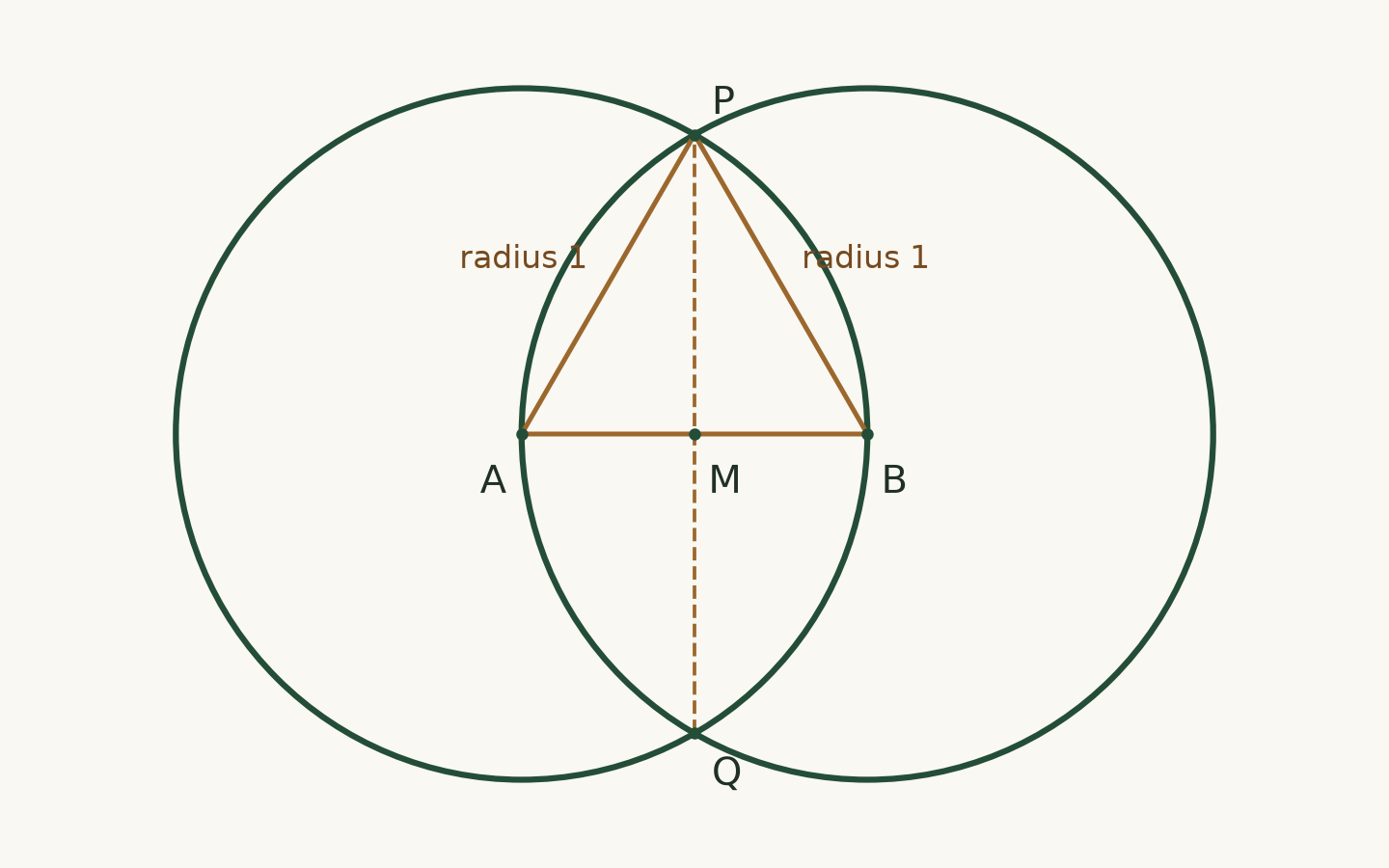
Original Euclidean diagram. The compass radius and distance between centers are both one unit; P and Q mark the intersections.
Now calculate the almond's height. Each crossing is equally distant from A and B, so it lies on their perpendicular bisector. Its upper crossing stands above the midpoint M of AB. In the right triangle AMP, AP is one and AM is one-half. Pythagoras gives MP² = 1 − 1/4 = 3/4, so MP = √3/2. The lower crossing is the same distance below AB. The full height is therefore √3 units, approximately 1.732. Its greatest horizontal width, along AB, is one unit.
That result depends on the setup. Keep both radii at one but move the centers √2 units apart. The crossing still lies over the midpoint, which is now √2/2 from each center. Its height above the centerline becomes √(1 − 1/2) = √2/2. The whole almond is √2 units tall, with width 2 − √2. An almond remains; the previous proportion does not.
This is a useful distinction when looking at an image. An almond-shaped outline can resemble the first construction without satisfying its exact dimensions. To establish the ratio, we would need the relevant measurements or evidence of the construction. To understand its use in a religious picture, we would also need to know what it surrounds and how that picture was understood. The resemblance gives us a promising question, not the whole answer.
What makes a rectangle golden
A golden rectangle offers a different pleasure: remove a square, and the remaining rectangle has the same proportions as the original when turned through a right angle.
Let the original short side be one unit and the long side be x, with x between one and two. This range makes the remaining side x − 1 shorter than one. Remove a one-by-one square from one end. The leftover rectangle has sides one and x − 1. Its long-to-short ratio is 1/(x − 1). For this to equal the original ratio x, we require x = 1/(x − 1). Multiplying gives x² − x − 1 = 0. The positive solution is x = (1 + √5)/2, approximately 1.618. This number is usually denoted by the Greek letter φ, phi.
Euclid defines the corresponding division of a line as an equality between two ratios: the whole to the larger segment equals the larger segment to the smaller. The familiar decimal expresses that relationship numerically. Our rectangle calculation is a modern way to see the same proportion at work. Euclid, Book VI, definition 3.
A rectangle one unit high and 1.6 units long may look close. But after removing its square, the remainder's ratio is 1/0.6 = 5/3, approximately 1.667. That differs from 1.6. “Nearly golden” can be a sensible description with a declared tolerance; it is not the exact self-similarity just established.
The property explains why a designer might find this rectangle interesting. Successive removal of squares offers a repeatable way to organize a drawing. It does not, by itself, tell us that every viewer prefers the result, that a particular building uses it or that a natural object has these dimensions. Those are questions about people and objects. They need observations suited to the claim.
Consider a clearly hypothetical photograph of a doorway. One person measures the outer frame; another measures the opening inside it. The two ratios differ. If either can choose a convenient edge after seeing the desired number, a persuasive overlay becomes easy to produce. A stronger examination specifies the edges first, gives the measured dimensions and explains the likely uncertainty. Evidence of a maker's intention would answer another question again.
A symbol needs a setting
A shape can carry meaning through its surroundings. Put a circle around a point and it may mark a target. Put it around a name and it may mark an answer. These ordinary examples do not settle religious interpretation, but they make its dependence on context familiar.
Geometric ornament can similarly belong to a building's practical arrangement, a craft tradition, a theological explanation or a modern contemplative exercise. Several roles can coexist. The Metropolitan Museum's account of Islamic ornament, for example, describes geometric forms used alongside calligraphic and vegetal decoration, across both architecture and objects. A geometric design need not be a detached code with one universal translation. The Met, “Geometric Patterns in Islamic Art”.
When a pattern attracts you, describe what can actually be seen before supplying a meaning. Then ask where the object comes from, what surrounds the pattern and which source supports the interpretation. A contemporary association may be valuable as your association. A historical assertion needs historical evidence. Keeping those descriptions distinct allows both to remain intelligible.
The two-circle drawing has now yielded something definite: equal radii and a specified separation produce a calculable height. It has also left something open: why anyone should treat the resulting form as sacred. That question leads into objects, texts and lives. The compass has done its work; the next kind of inquiry can begin.
For the broader relationship between models and matter, read First Principles of Geometry, Life, and Matter. The series overview introduces the historical, theological and contemplative questions that follow this article.
Loading comments…